 Arctic SDI catalogue
National Terrestrial Ecosystem Monitoring System (NTEMS)
Type of resources
Available actions
Topics
Keywords
Contact for the resource
Provided by
Formats
Representation types
Update frequencies
status
-

Landsat-derived forest age for Canada 2022 Satellite-based forest age map for 2022 across Canada's forested ecozones at a 30-m spatial resolution. Remotely sensed data from Landsat (disturbances, surface reflectance composites, forest structure) and MODIS (Gross Primary Production) are utilized to determine age. Age can be determined where disturbance can be identified directly (disturbance approach) or inferred using spectral information (recovery approach) or using inverted allometric equations to model age where there is no evidence of disturbance (allometric approach). The disturbance approach is based upon satellite data and mapped changes and is the most accurate. The recovery approach also avails upon satellite data plus logic regarding forest succession, with an accuracy that is greater than pure modeling. Given the lack of widespread recent disturbance over Canada's forests, the allometric approach is required over the greatest area (86.6%). Using information regarding realized heights and growth and yield modeling, ages are estimated where none are otherwise possible. Trees of all ages are mapped, with trees >150 years old combined in an - old tree - category. This product was developed within the framework of Canada’s National Terrestrial Ecosystem Monitoring System (NTEMS). See Maltman et al. (2023) for an overview of the methods, data, image processing, as well as information on agreement assessment using Canada's National Inventory (NFI). Maltman, J.C., Hermosilla, T., Wulder, M.A., Coops, N.C., White, J.C., 2023. Estimating and mapping forest age across Canada's forested ecosystems. Remote Sensing of Environment 290, 113529. ( Maltman et al. 2023).
-
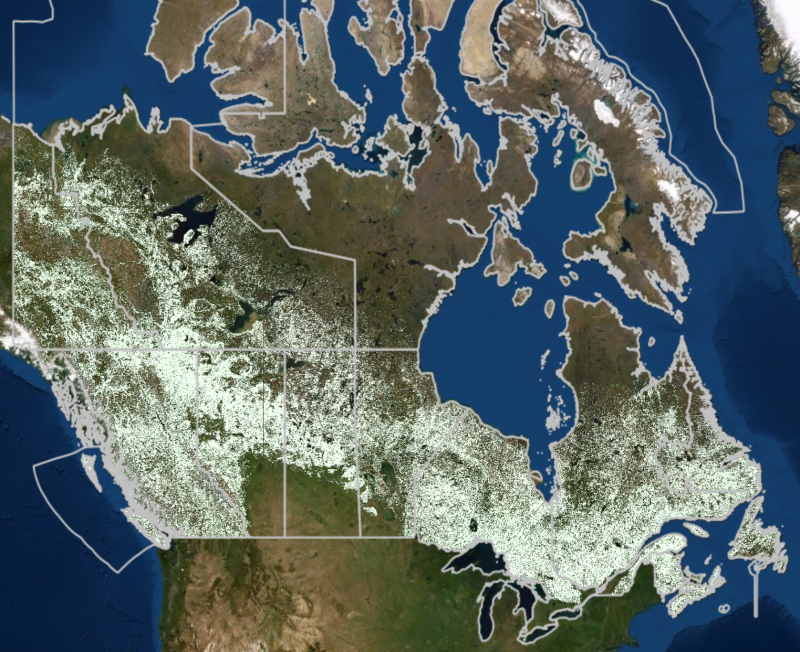
Forest Elevation(Ht) Covariance 2015 Coefficient of variation of first returns height (%). Represents the variability in canopy heights relative to the mean canopy height. It is developed within the framework of Canada’s National Terrestrial Ecosystem Monitoring System (NTEMS). Products relating the structure of Canada's forested ecosystems have been generated and made openly accessible. The shared products are based upon peer-reviewed science and relate aspects of forest structure including: (i) metrics calculated directly from the lidar point cloud with heights normalized to heights above the ground surface (e.g., canopy cover, height), and (ii) modelled inventory attributes, derived using an area-based approach generated by using co-located ground plot and ALS data (e.g., volume, biomass). Forest structure estimates were generated by combining information from lidar plots (Wulder et al. 2012) with Landsat pixel-based composites (White et al. 2014; Hermosilla et al. 2016) using a nearest neighbour imputation approach with a Random Forests-based distance metric. These products were generated for strategic-level forest monitoring information needs and are not intended to support operational-level forest management. All products have a spatial resolution of 30 m. For a detailed description of the data, methods applied, and accuracy assessment results see Matasci et al. (2018). When using this data, please cite as follows: Matasci, G., Hermosilla, T., Wulder, M.A., White, J.C., Coops, N.C., Hobart, G.W., Bolton, D.K., Tompalski, P., Bater, C.W., 2018b. Three decades of forest structural dynamics over Canada's forested ecosystems using Landsat time-series and lidar plots. Remote Sensing of Environment 216, 697-714. Matasci et al. 2018) Geographic extent: Canada's forested ecosystems (~ 650 Mha) Time period: 1985–2011
-

Wildfire change year 1985-2022. Wildfire changes occurred from 1985 to 2022 displaying the year of greatest wildfire disturbance. It is developed within the framework of Canada’s National Terrestrial Ecosystem Monitoring System (NTEMS). The information outcomes represent 38 years of wildfires in Canada's forests, derived from a single, consistent, spatially explicit data source in a fully automated manner. Time series of Landsat data with 30 m spatial resolution were used to characterize national trends in stand replacing forest disturbances caused by wildfire for the period 1985-2022 for Canada's 650-million-hectare forested ecosystems. When using this data, please cite as: Hermosilla, T., M.A. Wulder, J.C. White, N.C. Coops, G.W. Hobart, L.B. Campbell, 2016. Mass data processing of time series Landsat imagery: pixels to data products for forest monitoring. International Journal of Digital Earth 9(11), 1035-1054. https://doi.org/10.1080/17538947.2016.1187673 (Hermosilla et al. 2016). See references below for an overview on the data processing, metric calculation, change attribution, and time series change detection methods applied, as well as information on independent accuracy assessment of the data.. Hermosilla, T., Wulder, M. A., White, J. C., Coops, N.C., Hobart, G.W., (2015). An integrated Landsat time series protocol for change detection and generation of annual gap-free surface reflectance composites. Remote Sensing of Environment 158, 220-234. https://doi.org/10.1016/j.rse.2014.11.005 (Hermosilla et al. 2015a). Hermosilla, T., Wulder, M.A., White, J.C., Coops, N.C., Hobart, G.W., (2015). Regional detection, characterization, and attribution of annual forest change from 1984 to 2012 using Landsat-derived time-series metrics. Remote Sensing of Environment 170, 121-132. https://doi.org/10.1016/j.rse.2015.09.004 (Hermosilla et al. 2015b). Hermosilla, T., M.A. Wulder, J.C. White, N.C. Coops, G. W. Hobart, (2017). Updating Landsat time series of surface-reflectance composites and forest change products with new observations. International Journal of Applied Earth Observation and Geoinformation. 63,104-111. https://doi.org/10.1016/j.jag.2017.07.013 (Hermosilla et al. 2017).
-

This dataset provides wall-to-wall maps of forest structure across Canada's 650 million hectare forested ecosystems for the year 2022, generated at a spatial resolution of 30 m. It is developed within the framework of Canada’s National Terrestrial Ecosystem Monitoring System (NTEMS). Structure estimates include key attributes such as canopy height, canopy cover, and aboveground biomass, derived using a combination of airborne lidar and Landsat-based spectral composites. Structure models were trained using the - lidar-plot framework - (Wulder et al. 2012), which integrates co-located airborne lidar data and ground plot measurements with Landsat time-series composites (Hermosilla et al. 2016). A Nearest Neighbour imputation approach was applied to estimate structural attributes across the full extent of Canada's forested area. These nationally consistent products are intended to support strategic-level forest monitoring and assessment and are not designed for operational forest management. For further details on the methods, accuracy assessment, and source data, see Matasci et al. (2018). Matasci, G., Hermosilla, T., Wulder, M.A., White, J.C., Coops, N.C., Hobart, G.W., Bolton, D.K., Tompalski, P., Bater, C.W., 2018. Three decades of forest structural dynamics over Canada's forested ecosystems using Landsat time-series and lidar plots. Remote Sensing of Environment, 216, 697-714. https://doi.org/10.1016/j.rse.2018.07.024 (Matasci et al. 2018)
-

Forest Percentage Above 2m 2015 Percentage of first returns above 2 m (%). Represents canopy cover. It is developed within the framework of Canada’s National Terrestrial Ecosystem Monitoring System (NTEMS). Products relating the structure of Canada's forested ecosystems have been generated and made openly accessible. The shared products are based upon peer-reviewed science and relate aspects of forest structure including: (i) metrics calculated directly from the lidar point cloud with heights normalized to heights above the ground surface (e.g., canopy cover, height), and (ii) modelled inventory attributes, derived using an area-based approach generated by using co-located ground plot and ALS data (e.g., volume, biomass). Forest structure estimates were generated by combining information from lidar plots (Wulder et al. 2012) with Landsat pixel-based composites (White et al. 2014; Hermosilla et al. 2016) using a nearest neighbour imputation approach with a Random Forests-based distance metric. These products were generated for strategic-level forest monitoring information needs and are not intended to support operational-level forest management. All products have a spatial resolution of 30 m. For a detailed description of the data, methods applied, and accuracy assessment results see Matasci et al. (2018). When using this data, please cite as follows: Matasci, G., Hermosilla, T., Wulder, M.A., White, J.C., Coops, N.C., Hobart, G.W., Bolton, D.K., Tompalski, P., Bater, C.W., 2018b. Three decades of forest structural dynamics over Canada's forested ecosystems using Landsat time-series and lidar plots. Remote Sensing of Environment 216, 697-714. Matasci et al. 2018) Geographic extent: Canada's forested ecosystems (~ 650 Mha) Time period: 1985–2011
-

High-resolution annual forest land cover maps for Canada's forested ecosystems (1984-2022). It is developed within the framework of Canada’s National Terrestrial Ecosystem Monitoring System (NTEMS). The annual time series of forest land cover maps are national in scope (entire 650 million hectare forested ecosystem) and represent a wall-to-wall land cover characterization yearly from 1984 to 2022. These time-series land cover maps were produced from annual time-series of Landsat image composites, forest change information, and ancillary topographic and hydrologic data following the framework described in Hermosilla et al. (2022), which builds upon the approach introduced in Hermosilla et al. (2018). The methodological innovations included (i) a refined training pool derived from existing land cover products using airborne and spaceborne measures of forest structure; (ii) selection of training samples proportionally to the land cover distribution using a distance-weighted approach; and (iii) generation of regional classification models using a 150x150 km tiling system. Maps are post-processed using disturbance information to ensure logical class transitions over time using a Hidden Markov Model. Hidden Markov Models assess individual year class likelihoods to reduce variability and possible noise in year-on-year class assignments (for instances when class likelihoods are similar). Hermosilla, T., Wulder, M.A., White, J.C., Coops, N.C., 2022. Land cover classification in an era of big and open data: Optimizing localized implementation and training data selection to improve mapping outcomes. Remote Sensing of Environment. Vol. 268, No. 112780. https://doi.org/10.1016/j.rse.2021.112780. (Hermosilla et al. 2022) Hermosilla, T., M.A. Wulder, J.C. White, N.C. Coops, G. W. Hobart, (2018). Disturbance-Informed Annual Land Cover Classification Maps of Canada's Forested Ecosystems for a 29-Year Landsat Time Series. Canadian Journal of Remote Sensing. 44(1) 67-87.DOI: 10.1080/07038992.2018.1437719 (Hermosilla et al. 2018).
-

In this dataset, we share maps of annual dominant tree species (also known as leading tree species) from 1984-2022 covering the entirety of Canada's 650 Mha forested ecosystems using Landsat time-series imagery at a 30-m spatial resolution. It is developed within the framework of Canada’s National Terrestrial Ecosystem Monitoring System (NTEMS). Classifications are based on regionally representative Random Forests model using local training samples from Canada's National Forest Inventory (Hermosilla et al., 2024). Descriptive metrics provide information on spectral, geographic, climatic, and topographic characteristics. Initial annual tree species classifications were subjected to a time series post-classification process using the forward-backward Hidden Markov Model to improve the temporal consistency of tree species transitions within the time series. Assessment of the annual species maps using independent validation data resulted in an overall accuracy of 86.1% ± 0.14% (95%-confidence interval). These data allow consistent comparison of trends and rates of change in tree species composition nationally and across regions using a common time frame, spatial resolution, and analytical approach. Hermosilla, T., Wulder, M.A., White, J.C., Coops, N.C., Bater, C.W., Hobart, G.W., 2024. Characterizing long-term tree species dynamics in Canada's forested ecosystems using annual time series remote sensing data. Forest Ecology and Management, 122313. https://doi.org/10.1016/j.foreco.2024.122313 (Hermosilla et al. 2024)
-

Wildfire change magnitude 1985-2022. Spectral change magnitude for wildfires that occurred from 1985 to 2022. It is developed within the framework of Canada’s National Terrestrial Ecosystem Monitoring System (NTEMS). The wildfire change magnitude included in this product is expressed via differenced Normalized Burn Ratio (dNBR), computed as the variation between the spectral values before and after a given change event. Higher dNBR values are related to higher burn severity. Time series of Landsat data with 30-m spatial resolution were used to characterize national trends in stand replacing forest disturbances caused by wildfire for the period 1985-2022 for Canada's 650 million-hectare forested ecosystems. When using this data, please cite as: Hermosilla, T., M.A. Wulder, J.C. White, N.C. Coops, G.W. Hobart, L.B. Campbell, 2016. Mass data processing of time series Landsat imagery: pixels to data products for forest monitoring. International Journal of Digital Earth 9(11), 1035-1054. (Hermosilla et al. 2016). See references below for an overview on the data processing, metric calculation, change attribution and time series change detection methods applied, as well as information on independent accuracy assessment of the data. Hermosilla, T., Wulder, M. A., White, J. C., Coops, N.C., Hobart, G.W., 2015. An integrated Landsat time series protocol for change detection and generation of annual gap-free surface reflectance composites. Remote Sensing of Environment 158, 220-234. (Hermosilla et al. 2015a). Hermosilla, T., Wulder, M.A., White, J.C., Coops, N.C., Hobart, G.W., 2015. Regional detection, characterization, and attribution of annual forest change from 1984 to 2012 using Landsat-derived time-series metrics. Remote Sensing of Environment 170, 121-132. (Hermosilla et al. 2015b).
-

Forest Basal Area 2015 Cross-sectional area of tree stems at breast height. It is developed within the framework of Canada’s National Terrestrial Ecosystem Monitoring System (NTEMS). The sum of the cross-sectional area (i.e. basal area) of each tree in square metres in a plot, divided by the area of the plot (units = m2ha). Products relating the structure of Canada's forested ecosystems have been generated and made openly accessible. The shared products are based upon peer-reviewed science and relate aspects of forest structure including: (i) metrics calculated directly from the lidar point cloud with heights normalized to heights above the ground surface (e.g., canopy cover, height), and (ii) modelled inventory attributes, derived using an area-based approach generated by using co-located ground plot and ALS data (e.g., volume, biomass). Forest structure estimates were generated by combining information from lidar plots (Wulder et al. 2012) with Landsat pixel-based composites (White et al. 2014; Hermosilla et al. 2016) using a nearest neighbour imputation approach with a Random Forests-based distance metric. These products were generated for strategic-level forest monitoring information needs and are not intended to support operational-level forest management. All products have a spatial resolution of 30 m. For a detailed description of the data, methods applied, and accuracy assessment results see Matasci et al. (2018). When using this data, please cite as follows: Matasci, G., Hermosilla, T., Wulder, M.A., White, J.C., Coops, N.C., Hobart, G.W., Bolton, D.K., Tompalski, P., Bater, C.W., 2018b. Three decades of forest structural dynamics over Canada's forested ecosystems using Landsat time-series and lidar plots. Remote Sensing of Environment 216, 697-714. Matasci et al. 2018) Geographic extent: Canada's forested ecosystems (~ 650 Mha) Time period: 1985–2011
-

High-resolution map of leading tree species distribution for Canada’s forested ecosystems (2019). Leading tree species map produced from a 2019 Landsat image composite, geographic and climate data, elevation derivatives, and remote sensing derived phenology following the framework described in Hermosilla et al. (2022). Regional classification models were generated based on Canada’s National Forest Inventory using a 150x150 km tiling system. The leading tree species are defined by representing the most voted tree species from the Random Forests classification models (i.e. the class with the highest class membership probability).The data represents leading tree species of Canada's forested ecosystems in 2019. An image compositing window of August 1 ± 30 days was used to generate the best-available-pixel (BAP) image composites utilized as source data for the classification. The science and methods developed to generate the information outcomes shown here, that track and characterize the history of Canada’s forests, were led by Canadian Forest Service of Natural Resources Canada, developed within the framework of Canada’s National Terrestrial Ecosystem Monitoring System (NTEMS), partnered with the University of British Columbia, augmented by processing capacity from Digital Research Alliance of Canada. For an overview on the data, image processing, and methods applied, as well as information on independent accuracy assessment of the data, see Hermosilla et al. (2022) https://doi.org/10.1016/j.rse.2022.113276 When using this data, please cite as: Hermosilla, T., Bastyr, A., Coops, N.C., White, J.C., Wulder, M.A., 2022. Mapping the presence and distribution of tree species in Canada’s forested ecosystems. Remote Sensing of Environment 282, 113276.