 Arctic SDI catalogue
Iceland scallop
Type of resources
Categories
Topics
Keywords
Contact for the resource
Provided by
Formats
Representation types
Update frequencies
status
-

Summary The Quebec region of the Department of Fisheries and Oceans (DFO) is responsible for the assessment of several fish and invertebrate stocks exploited in the Estuary and the northern Gulf of St. Lawrence. The commercial catches sampling program is one of the sources of information used to complete these assessments. The data collected by this program, at wharf or at sea, offers among other things the advantage of a relatively large spatio-temporal coverage and provides some of the necessary knowledge to assess the demography and the structure of the exploited populations. This program is implemented by specialized DFO staff whose main mandate is to collect biological data on groundfish, pelagic fish and marine invertebrate species that are commercially exploited in the various marine communities. Data This dataset on the iceland scallop (Chlamys islandica) includes the metadata, shell height and the number shells (empty or full) for all the specimens measured. This dataset covers the periods of 1985-2009 and 2011 to present. In order to protect the confidentiality of the sources, some informations (such as those concerning the vessel) have been excluded and others (such as the date of capture) have been simplified. Entries where there was only one vessel in a fishing area for a given year were also excluded. Further information including the fishing areas coordinates can be found by clicking on the «Atlantic and Arctic commercial fisheries» and «Fishing areas» links below.
-

Sea scallop (Placopecten magellanicus) and Iceland scallop (Chlamys islandica) concentration areas of this layer are described as being known and commercially exploited historically and/or currently. The mapping of these areas is based on several sources of information: research surveys (since 1977, annually but alternating sectors since 2009), exploratory fisheries (2000, 2001, 2003) and commercial fisheries (annually). These concentration areas are considered among the most abundant beds and are used for commercial fishing. This layer does not represent the general distribution of the species nor the extent to which fishing is allowed and does not take into account the large unexploited beds. The extent of shellfish beds can change over time in response to, among others, harvesting and recruitment rates. The polygons might underestimate the concentration areas because fishing and scientific surveys occurred where the target resource was known to be more abundant. However, the precision is good enough for resource protection and management needs in case of an environmental incident. This information is valid until data from a more recent research survey is published. Data sources and references: Bourdages, H. et Goudreau, P. 2010. Évaluation des stocks de pétoncles des eaux côtières du Québec en 2009 : données de la pêche commerciale. Secr. can. de consult. sci. du MPO. Doc. de rech. 2010/068. viii + 69 p. Giguère, M., Brulotte, S. et Goudreau, P. 2000. État des stocks de pétoncles des eaux côtières du Québec. Secr. can. de consult. sci. du MPO. Doc. de rech. 2000/086. xi + 46 p. Trottier, S., Bourdages, H., Goudreau, P et Brulotte, S. 2017. Évaluation des stocks de pétoncle des eaux côtières du Québec en 2015: données de la pêche commerciale, des relevés de recherche et des pêches exploratoires. Secr. can. de consult. sci. du MPO. Doc. de rech. 2017/037: xvi + 176 p.
-
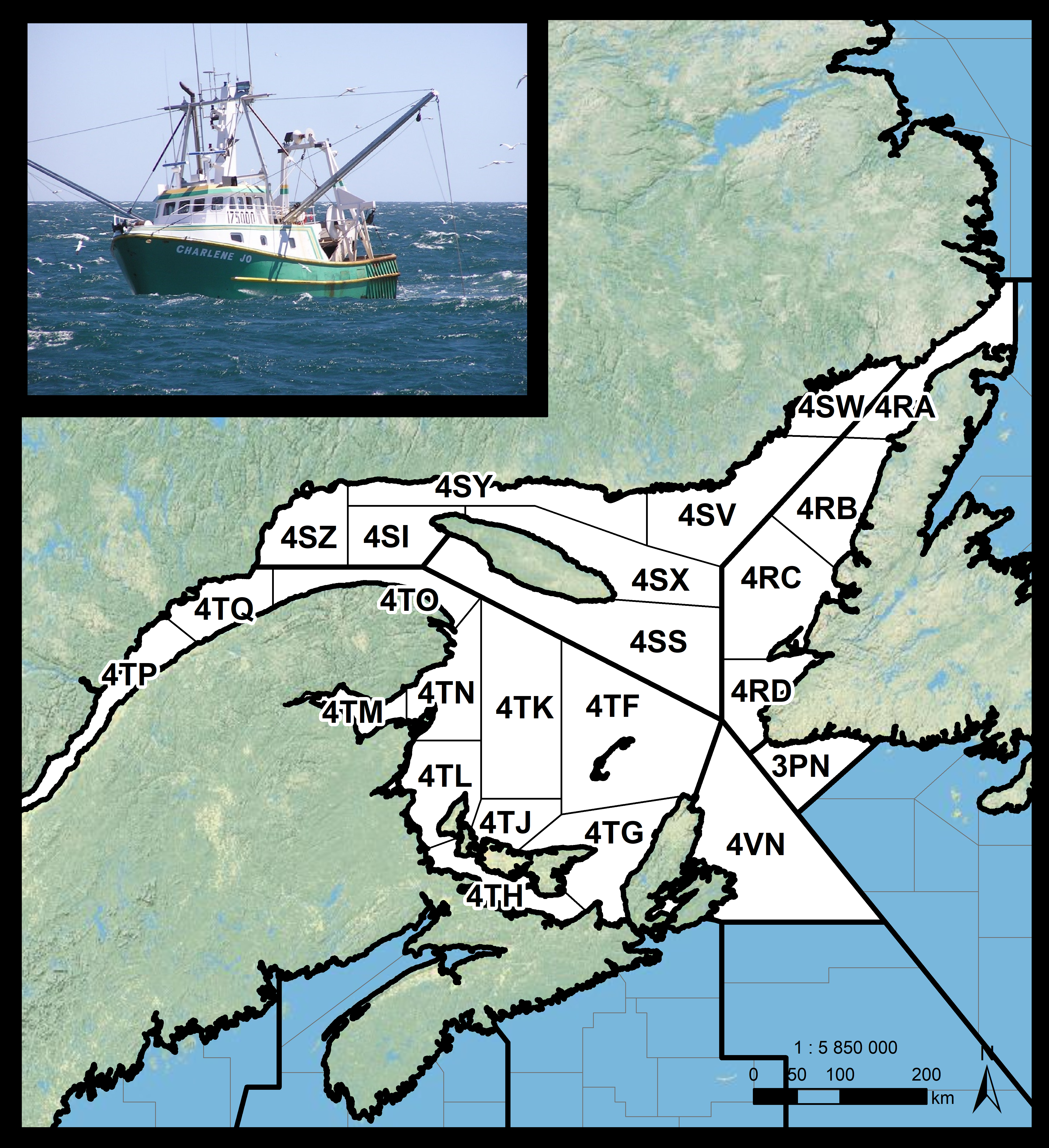
The Quebec region of the Department of Fisheries and Oceans (DFO) is responsible for the assessment of several fish and invertebrate stocks exploited in the Estuary and the northern Gulf of St. Lawrence. The commercial catches sampling program is one of the sources of information used to complete these assessments. The data collected by this program, at wharf or at sea, offers among other things the advantage of a relatively large spatio-temporal coverage and provides some of the necessary knowledge to assess the demography and the structure of the exploited populations. This program is implemented by specialized DFO staff whose main mandate is to collect biological data on groundfish, pelagic fish and marine invertebrate species that are commercially exploited in the various marine communities. The following species have been sampled by this program from 1976 to present: 1. American lobster (Homarus americanus) 2. American plaice (Hippoglossoides platessoides) 3. Atlantic cod (Gadus morhua) 4. Atlantic halibut (Hippoglossus hippoglossus) 5. Atlantic herring (Clupea harengus) 6. Atlantic lyre crab (Hyas araneus) 7. Atlantic mackerel (Scomber scombrus) 8. Atlantic surfclam (Spisula solidissima) 9. Arctic Lyre Crab (Hyas coarctatus) 10. Capelin (Mallotus villosus) 11. Common softshell clam (Mya arenaria) 12. Giant scallop (Placopecten magellanicus) 13. Greenland halibut (Reinhardtius hippoglossoides) 14. Green urchin (Strongylocentrotus droebachiensis) 15. Iceland scallop (Chlamys islandica) 16. Redfish (Sebastes sp.) 17. Rock crab (Cancer irroratus) 18. Sea cucumber (Cucumaria frondosa) 19. Snow crab (Chionoecetes opilio) 20. Stimpson surfclam (Mactromeris polynyma) 21. Waved whelk (Buccinum undatum) 22. White hake (Urophycis tenuis) 23. Winter flounder (Pseudopleuronectes americanus) 24. Yellowtail flounder (Limanda ferruginea) For more information concerning these species, see the «Related Products» section below.