 Arctic SDI catalogue
Marine Conservation Targets (MCT)
Type of resources
Topics
Keywords
Contact for the resource
Provided by
Formats
Representation types
Update frequencies
status
-

As part of the Musquash Marine Protected Area (MPA) Monitoring Plan, this project was implemented to establish a baseline for infaunal biodiversity for this area. Data collection began in 2010 and contributed monitoring information for productivity, biodiversity, and habitat indicators within the Musquash Harbour. A 1500 cubic centimetre ponar benthic grab was deployed at 30 random stations distributed over three strata (channel, intertidal and subtidal). Samples were to be collected up to three times per year to account for seasonality and annual variation. Once collected the benthic samples were analyzed for changes in grain size, carbon content (Loss on ignition), species abundance/diversity and biomass. Cite this data as: Cooper, J.A., and Blanchard, M. Musquash Benthic Infauna. Published in September 2023. Coastal Ecosystem Science Division, Fisheries and Oceans Canada, St. Andrews, NB. For additional information please see: Cooper, A., Abbott, M., Allard, K., Chang,, B., Courtenay, S., Doherty, P., Greenlaw, M., Ipsen, E., Koropatnick, T., Law, B., Losier, R., Martin, J., Methven, D., and Page, F. 2014. Musquash Estuary Marine Protected Area (MPA): Data Assessment. DFO Can. Sci. Advis. Sec. Res. Doc. 2014/001. v + 57 p. Cooper, J.A., Jones, O. and Blanchard, M. 2023. Review of Baseline Monitoring within the Musquash Estuary Marine Protected Area. DFO Can. Sci. Advis. Sec. Res. Doc. 2023/028. viii + 56 p. Oceans and Coastal Management Division (OCMD). 2015. Musquash Estuary Marine Protected Area Ecosystem Monitoring Plan (2014-2019). Can. Manuscr. Rep. Fish Aquat. Sci. 3077: v+17 pp. DFO. 2022. 2021 Review of Musquash Marine Protected Area Monitoring. DFO Can. Sci. Advis. Sec. Sci. Advis. Rep. 2022/016.
-
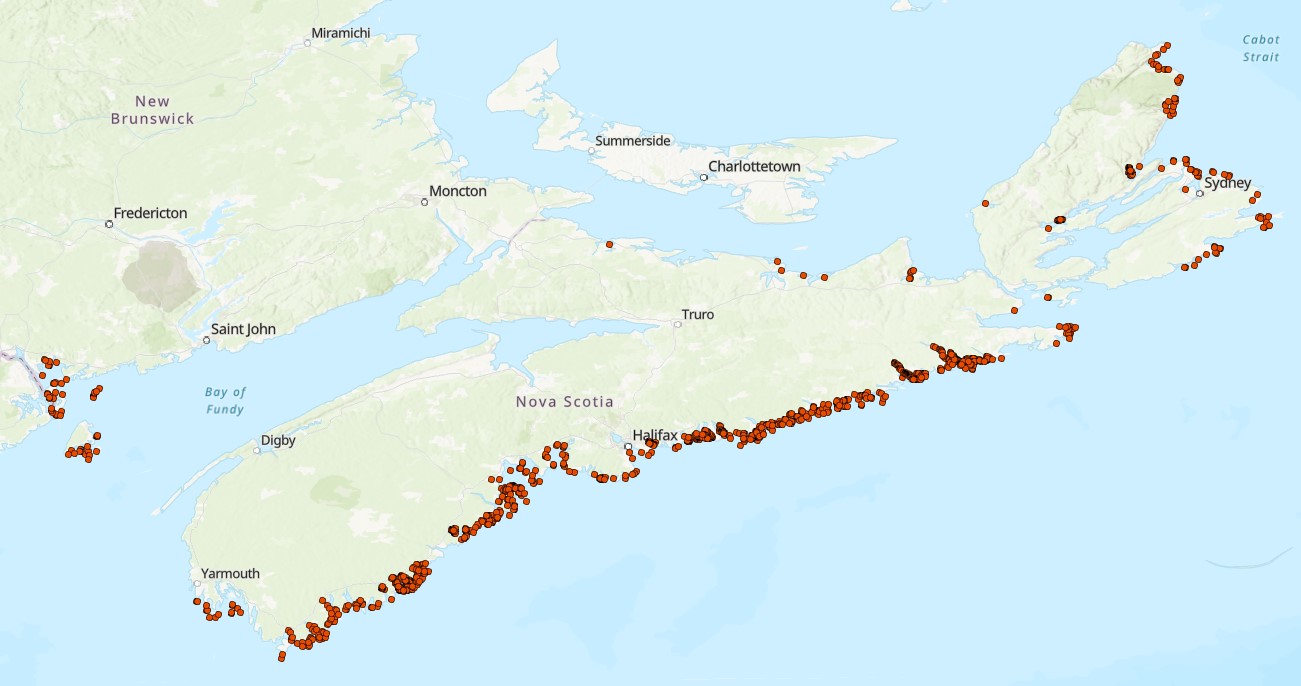
This is a collection of eelgrass (Zostera marina) presence and absence records collected between 2009-2025 in coastal waters in Nova Scotia, Canada. The data collection has been collated by the Coastal Benthic Ecology Lab (CBEL) at the Bedford Institute of Oceanography, Fisheries and Oceans Canada (DFO) under the supervision of Dr. Melisa Wong. Records include those from various research groups at DFO, Nova Scotia provincial departments, academia, and non-profit organizations. Data were collected using various methods including field measurements of eelgrass presence or absence via boat, snorkel and drop camera video transects, surface observations, and various sample collections (including plants, core, sediment, trawl, pop net, seine, etc.). Please see specific record references for associated metadata and detailed descriptions of the methods for eelgrass occurrence data collection. Where available, water depth (m) and substrate type (rock, soft, or mixed) are provided. The substrate type (hard substrate, mixed, mud, rocky, sand, or various combinations) used for the species distribution model published by O’Brien et al. 2022 is also provided where available. The data owner, data source (i.e., reference(s)), and use of the data in the species distribution model of O’Brien et al. 2022 are provided. All records from sources external to DFO are included under data sharing agreements or permission from the data owner. Cite this data as: Wong, M.C., Fraser, M., Thomson, J. A., O’Brien, J. Data of eelgrass (Zostera marina) occurrences in Nova Scotia. Published: April 2026. Coastal Ecosystems Science Division, Maritimes Region, Fisheries and Oceans Canada, Dartmouth NS.