 Arctic SDI catalogue
Atlantic halibut
Type of resources
Topics
Keywords
Contact for the resource
Provided by
Formats
Representation types
Update frequencies
status
-

Summary The Quebec region of the Department of Fisheries and Oceans (DFO) is responsible for the assessment of several fish and invertebrate stocks exploited in the Estuary and the northern Gulf of St. Lawrence. The commercial catches sampling program is one of the sources of information used to complete these assessments. The data collected by this program, at wharf or at sea, offers among other things the advantage of a relatively large spatio-temporal coverage and provides some of the necessary knowledge to assess the demography and the structure of the exploited populations. This program is implemented by specialized DFO staff whose main mandate is to collect biological data on groundfish, pelagic fish and marine invertebrate species that are commercially exploited in the various marine communities. Data This dataset on the Atlantic halibut (Hippoglossus hippoglossus) includes the metadata, sample weight, fish length, the sex and the number of specimens measured. This dataset covers the period of 1995 to present. In order to protect the confidentiality of the sources, some informations (such as those concerning the vessel) have been excluded and others (such as the date of capture) have been simplified. Entries where there was only one vessel in a fishing area for a given year were also excluded. Further information including the fishing areas coordinates can be found by clicking on the «Atlantic and Arctic commercial fisheries» and «Fishing areas» links below.
-
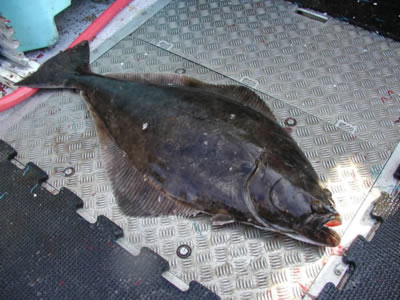
Since 2017, industry-supported scientific surveys targeting Atlantic halibut (Hippoglossus hippoglossus) have been conducted in the Gulf of St. Lawrence and parts of the estuary. The primary objective of the project is to gather data on the species' abundance, distribution, and biological characteristics. To achieve this, a stratified random longline survey is carried out, during which Atlantic halibut of all sizes are measured and tagged using two spaghetti tags. Beginning in 2024, tissue samples from the pelvic fin of each individual were also collected for genetic analysis. Atlantic halibut are captured using longlines equipped with 500 circle hooks. While the length of the leaders varies among vessels, the spacing between leaders ranges from 3.6 to 5.5 meters. Fork length is measured for each individual of commercial species caught - such as Atlantic halibut, cod, redfish, and Greenland halibut (turbot). Measurements are also occasionally taken for non-commercial species. This publication includes the file Donnees_Releve_Fletan_Halibut_Survey_Data, which provides information associated with each sampled station. It also contains the number of Atlantic halibut, cod, redfish and Greenland halibut (turbot) caught at each station. It is important to note that only beginning in 2019 were all commercial species systematically measured. The "NA" values in 2017–2018 do not indicate that no individuals were caught, but rather that they were not measured systematically. Note: There are missing data in various columns of the dataset - use data with caution - if you have any questions please contact the data management team gddaiss-dmsaisb@dfo-mpo.gc.ca.