 Arctic SDI catalogue
Précipitation
Type of resources
Categories
Available actions
Keywords
Contact for the resource
Provided by
Years
Representation types
Update frequencies
status
Service types
-
This series of datasets has been created by AAFC’s National Agroclimate Information Service (NAIS) of the Agro-Climate, Geomatics and Earth Observations (ACGEO) Division of the Science and Technology Branch. The Canadian Drought Monitor (CDM) is a composite product developed from a wide assortment of information such as the Normalized Difference Vegetation Index (NDVI), streamflow values, Palmer Drought Index, and drought indicators used by the agriculture, forest and water management sectors. Drought prone regions are analyzed based on precipitation, temperature, drought model index maps, and climate data and are interpreted by federal, provincial and academic scientists. Once a consensus is reached, a monthly map showing drought designations for Canada is digitized. AAFC’s National Agroclimate Information Service (NAIS) updates this dataset on a monthly basis, usually by the 10th of every month to correspond to the end of the previous month, and subsequent Canadian input into the larger North American Drought Monitor (NA-DM). The drought areas are classified as follows: D0 (Abnormally Dry) – represents an event that occurs once every 3-5 years; D1 (Moderate Drought) – represents an event that occurs every 5-10 years; D2 (Severe Drought) – represents an event that occurs every 10-20 years; D3 (Extreme Drought) – represents an event that occurs every 20-25 years; and D4 (Exceptional Drought) – represents an event that occurs every 50 years. Impact lines highlight areas that have been physically impacted by drought. Impact labels specify the longitude and magnitude of impacts. The impact labels are classified as follows: S – Short-Term, typically less than 6 months (e.g. agriculture, grasslands). L – Long-Term, typically more than 6 months (e.g. hydrology, ecology).
-
The first version of this gridded dataset (on a 10-km EASE grid) of monthly total precipitation amounts was produced using a kriging-based gridding scheme to grid the Canadian homogenized monthly precipitation dataset CanHoPmlyV1 (Wang et al. 2023; available at https://open.canada.ca/data/dataset/1dd0c28e-2266-42e2-8985-2f47659e9d02). More specifically, ordinary kriging was used to grid the 1961-1990 climate normal values and the relative anomalies, separately; the resulting gridded datasets were used to produce this gridded dataset of monthly total precipitation amounts (Wang et al. 2023, Abbasnezhadi and Wang, 2024). As detailed in Wang et al. (2023), CanHomPmlyV1 is based on the quality-controlled version 2020 of the Adjusted Daily Rainfall and Snowfall (AdjDlyRS) dataset (Wang et al. 2017, available at https://open.canada.ca/data/en/dataset/d8616c52-a812-44ad-8754-7bcc0d8de305), and on daily total precipitation data from automated gauges (including Belfort, Fisher & Porter, Nipher, Geonor, and Pluvio), with some records from neighbouring stations being joined to form long-term data series. Version 1 of ANUSPLIN surfaces of the adjusted monthly precipitation (MacDonald et al. 2021) was used to infill temporal data gaps in the 425 data series. A comprehensive semi-automatic data homogenization procedure was used to homogenize the data series. The aforementioned ANUSPLIN data and the Twentieth Century Reanalysis 20CRv3 ensemble-mean series of monthly precipitation (Slivinski et al., 2019) were used as reference in the homogeneity tests (Wang et al., 2023). The homogenized dataset CanHoPmlyV1, and its gridded version CanGridP mlyV1, which was called CanKrig mlyPv1 in Wang et al. (2023), provide more realistic estimates of precipitation trends (Wang et al. 2023). Although the latter is much better than the pre-existing CanGRD precipitation relative anomalies data, both gridded datasets contain biases due to changes in data availability over time and space (i.e., inhomogeneous sampling), which are non-negligible in the early period. Such biases are being assessed and corrected to produce a sampling bias-corrected gridded dataset CanGridP mlyV2 (upcoming). References: Abbasnezhadi, K. and X. L. Wang, 2024: Comparison of gridding methods for precipitation over Canada and assessment of station/data density effects on gridding results. Atmos.-Ocean, 62:4, 320-346, https://doi.org/10.1080/07055900.2024.2394829. Wang, X.L, Y. Feng, V. Y. S. Cheng, H. Xu, 2023: Observed precipitation trends inferred from Canada’s homogenized monthly precipitation dataset, J. Clim., 36, 7957-7971. DOI: 10.1175/JCLI-D-23-0193.1. Wang, X. L., H. Xu, B. Qian, Y. Feng, E. Mekis, 2017: The adjusted daily rainfall and snowfall data for Canada. Atmos.-Ocean, 55:3, 155-168, DOI:10.1080/07055900.2017.1342163. MacDonald, H., D. W. McKenney, X. L. Wang, J. Pedlar, P. Papadopol, K. Lawrence, M. F. Hutchinson, 2021: Spatial Models of adjusted precipitation for Canada at varying time scales. J. Appl. Meteor. And Climatol., 60, 291-304. DOI: 10.1175/JAMC-D-20-0041.1. Slivinski, L. and coauthors, 2019: Towards a more reliable historical reanalysis: Improvements for version 3 of the Twentieth Century Reanalysis system. Q. J. R. Meteor. Soc., 2876-2908, https://doi.org/10.1002/qj.3598.
-
The Drought Impact Label dataset is used on all drought polygons from D1 to D4 to specify the longitude and magnitude of impacts. Impact labels are often used in association with the Drought Impact Line dataset. The impact labels are classified as follows: S – Short-Term, typically less than 6 months. L – Long-Term, typically more than 6 months. SL – A combination of Short and Long-Term impacts.
-
The Drought Impact Lines dataset highlights areas that have been physically impacted by drought. All drought impact lines have a drought impact label inside of them to express the longevity of the impact. The impact lines are classified using impact labels as follows: S – Short-Term, typically less than 6 months. L – Long-Term, typically more than 6 months. SL – A combination of Short and Long-Term impacts.
-
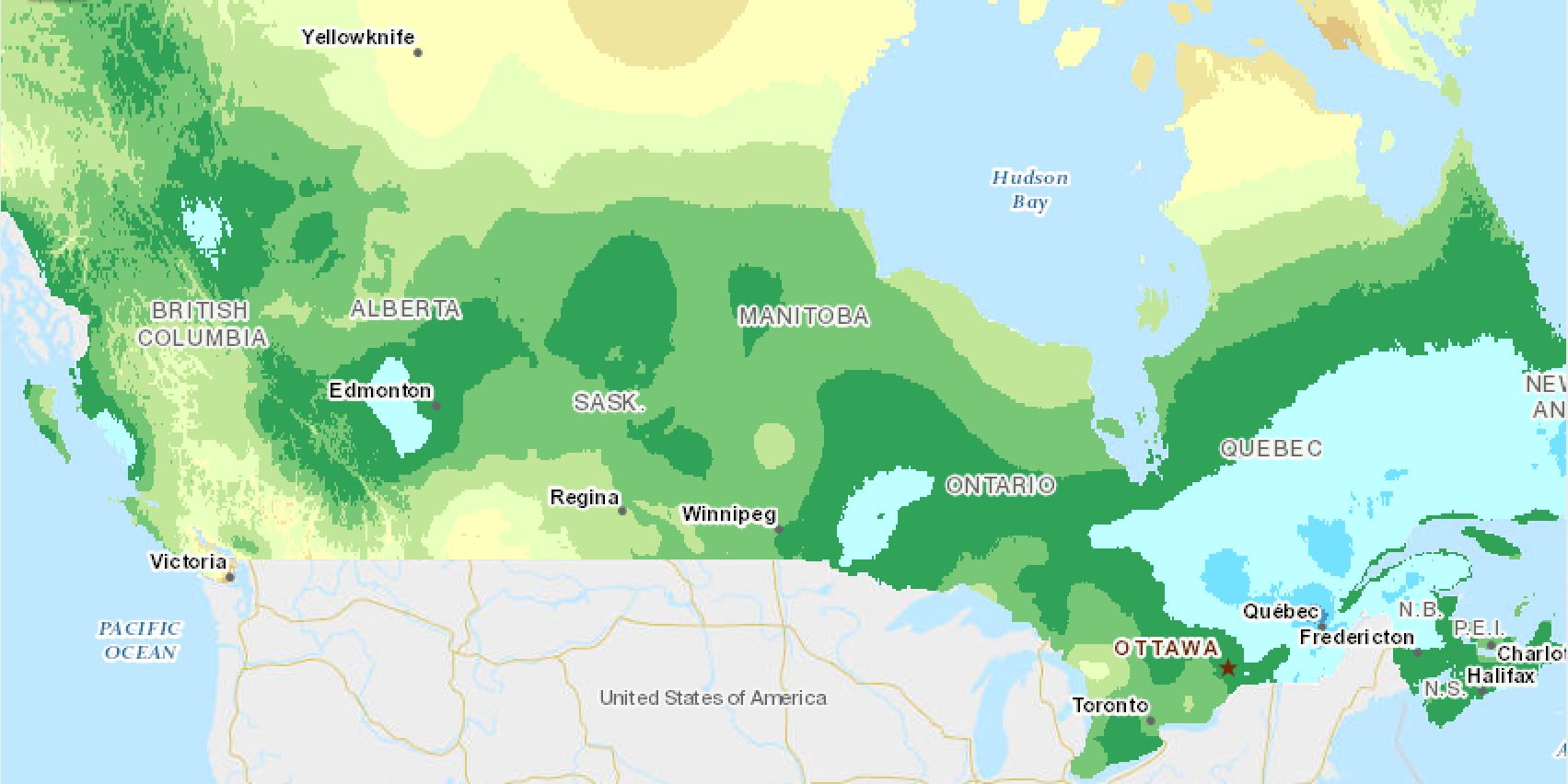
30-year Average precipitation represents the average amount (mm) of precipitation received in a month across a 30 year period (1961-1991, 1971-2000, 1981-2010, 1991-2020). These values are calculated across Canada in 10x10 km cells.
-
This data represents the dryness of the land surface based on vegetation conditions. The data is created weekly and uses weekly information on precipitation anomalies (namely the Standardized Precipitation Index or SPI) and satellite vegetation condition derived from Normalized Difference Vegetation Index (NDVI) from the MODIS Satellite. These dynamic data sets along with static data sets on land cover, soil water holding capacity, irrigation, ecozones and land surface elevation are used to model the drought severity, based on the Palmer Drought Severity Index (PDSI). The mapcubist model was trained on historical data and applied in real time to the dynamic inputs to produce drought severity ratings. The model is run at a 1km resolution and was developed by the AAFC, the United States Geological Survey and the United States Drought Monitor at the University of Nebraska Lincoln.
-
Ce produit fournit les données sur les eaux de ruissellement où chaque ligne de contour correspond à une quantité annuelle moyenne d’eau de ruissellement (en millimètres). Les données sur les eaux de ruissellement ont été dérivées des valeurs de débit provenant des stations hydrométriques ayant un débit naturel. Pour des raisons liées à la qualité ou à l’accessibilité des données, les données de certaines régions du pays ne sont pas offertes pour toutes les années. Les données couvrent la période de 1971 à 2013 pour le sud et de 1971 à 2004 pour le nord. Ces fichiers ont été produits par Statistique Canada, Division de la statistique de l’environnement, de l’énergie et des transports, 2017, basés sur des données d’Environnement et Changement climatique Canada, 2015, Relevés hydrologiques du Canada, Données hydrométriques archivées (HYDAT), www.ec.gc.ca/rhc- wsc/default.asp?lang=Fr&n=4EED50F1-1 (site consulté le 3 décembre 2015); C. Spence et A. Burke, 2008, « Estimates of Canadian Arctic Archipelago runoff from observed hydrometric data », Journal of Hydrology, vol. 362, p. 247 à 259. Pour en savoir plus sur la méthodologie, les résultats et les limites, veuillez consulter l’annexe D dans le document Statistique Canada, 2017, « L’eau douce au Canada, » L’activité humaine et l’environnement, Catalogue no 16-201-X. L’objet de l’ensemble de données est de présenter sur une carte nationale à l’échelle du 1 : 32 000 000 les quantités d’eau de ruissellement dérivées du modèle du rendement de l’eau de Statistique Canada. Ce produit est conçu pour être utilisé à des fins de référence ou de cartographie. Sa couverture est délimitée par les littoraux canadiens, tels qu’ils sont définis par les limites des régions de drainage fournies dans la carte 1.1 Régions de drainage du Canada. Le produit ne couvre pas les îles de l’Arctique. Il incombe aux utilisateurs de vérifier que le produit convient à l’utilisation prévue.
-
Ce produit fournit les données sur les eaux de ruissellement où chaque ligne de contour correspond à une quantité annuelle moyenne d’eau de ruissellement (en millimètres). Les données sur les eaux de ruissellement ont été dérivées des valeurs de débit provenant des stations hydrométriques ayant un débit naturel. Pour des raisons liées à la qualité ou à l’accessibilité des données, les données de certaines régions du pays ne sont pas offertes pour toutes les années. Les données couvrent la période de 1971 à 2013 pour le sud et de 1971 à 2004 pour le nord. Ces fichiers ont été produits par Statistique Canada, Division de la statistique de l’environnement, de l’énergie et des transports, 2017, basés sur des données d’Environnement et Changement climatique Canada, 2015, Relevés hydrologiques du Canada, Données hydrométriques archivées (HYDAT), www.ec.gc.ca/rhc- wsc/default.asp?lang=Fr&n=4EED50F1-1 (site consulté le 3 décembre 2015); C. Spence et A. Burke, 2008, « Estimates of Canadian Arctic Archipelago runoff from observed hydrometric data », Journal of Hydrology, vol. 362, p. 247 à 259. Pour en savoir plus sur la méthodologie, les résultats et les limites, veuillez consulter l’annexe D dans le document Statistique Canada, 2017, « L’eau douce au Canada, » L’activité humaine et l’environnement, Catalogue no 16-201-X. L’objet de l’ensemble de données est de présenter sur une carte nationale à l’échelle du 1 : 32 000 000 les quantités d’eau de ruissellement dérivées du modèle du rendement de l’eau de Statistique Canada. Ce produit est conçu pour être utilisé à des fins de référence ou de cartographie. Sa couverture est délimitée par les littoraux canadiens, tels qu’ils sont définis par les limites des régions de drainage fournies dans la carte 1.1 Régions de drainage du Canada. Le produit ne couvre pas les îles de l’Arctique. Il incombe aux utilisateurs de vérifier que le produit convient à l’utilisation prévue.
-
The “Soil Landscapes of Canada (SLC) Version 2.2” dataset series provides a set of geo-referenced soil areas (polygons) that are linked to attribute data found in the associated Component Table (CMP), Landscape Table (LAT), Carbon Layer Table (CLYR), and Dom/Sub File (DOM_SUB). Together, these datasets describe the spatial distribution of soils and associated landscapes for Canada.
-
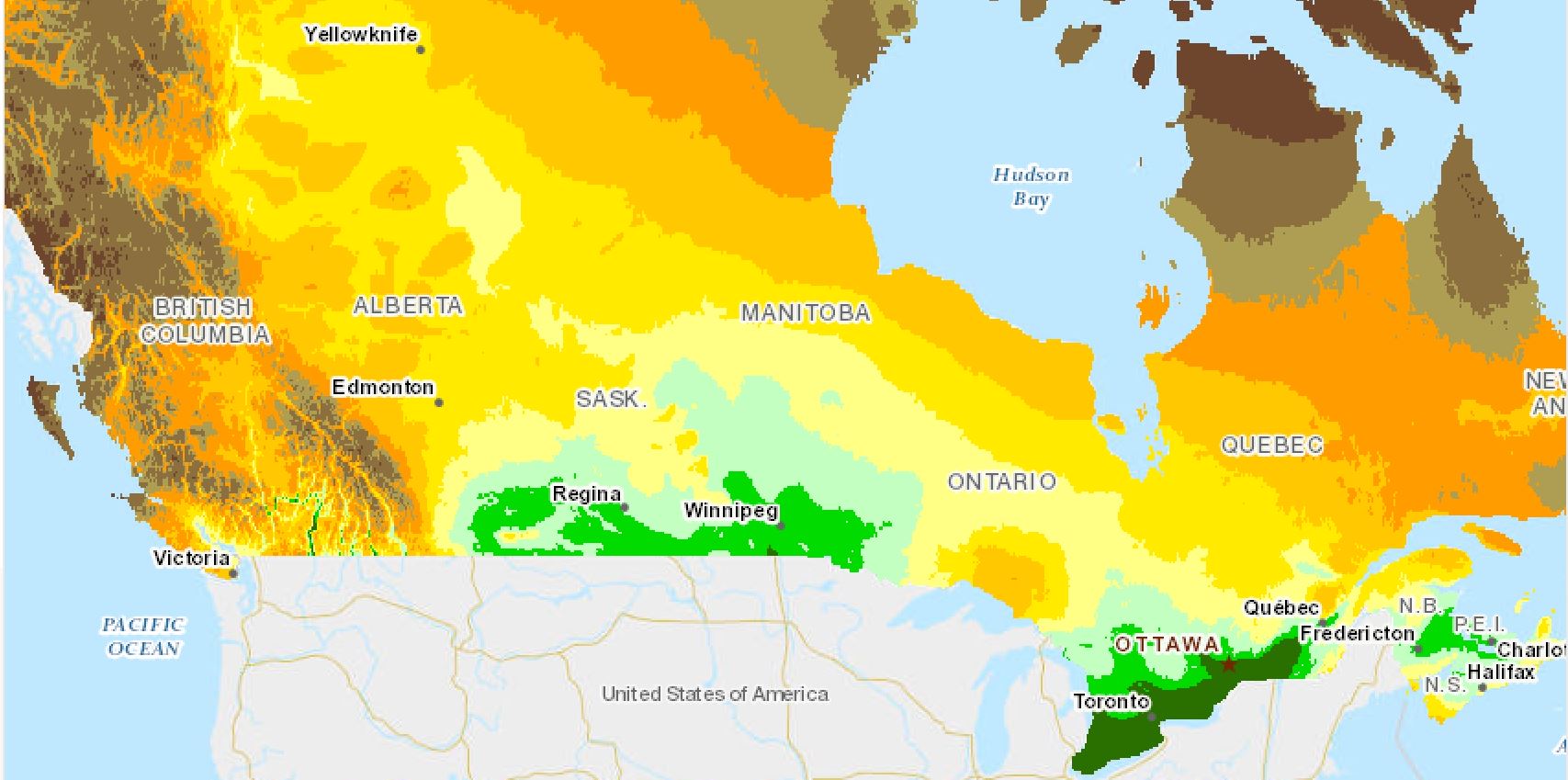
Growing Degree Days (GDDs) are used to estimate the growth and development of plants and insects during the growing season. Insect and plant development are very dependent on temperature and the daily accumulation of heat. The amount of heat required to move a plant or pest to the next development stage remains constant from year to year. However, the actual amount of time (days) can vary considerably from year to year because of weather conditions. Base temperatures are a point below which development does not occur for the organism in question. Base 15 temperatures are commonly used for general insect development. These values are calculated across Canada in 10x10 km cells.