 Arctic SDI catalogue
Communications
Type of resources
Categories
Topics
Keywords
Contact for the resource
Provided by
Formats
Representation types
Update frequencies
status
Scale
-

The Atlas of Canada High Speed Internet Network map illustrates the availability of high-speed internet across Canada in 2024. High speed internet service is broken up into 4 download speeds in Megabits per second. 25 Mbps, 50 Mbps, 100 Mbps, and Gigabit (940 Mbps). It features an inset map and a bar graph that provide additional insights. The inset map shows the percentage of population in each province with access to 50 Mbps internet. The bar graph shows the percent of population without access 50 Mbps internet by year, dating back to 2018. The Atlas of Canada High Speed Internet Network map is shown at a scale of 1:6 000 000. It is part of the new Atlas of Canada series, which features a shared look and feel across all map products to ensure consistency in design and layout. This map supports the Communication and Transportation theme, one of five core themes featured in the renewed Atlas of Canada web presence at atlas.gc.ca. The common design helps make Atlas of Canada products easier to read, compare, and use together across the Atlas collection Use the Atlas of Canada site to find places, digital maps, facts, geographical information and learning resources about Canada. Source: Canadian Radio-television and Telecommunications Commission (CRTC), 2025. Current trends - High-speed broadband. https://crtc.gc.ca/eng/publications/reports/PolicyMonitoring/ban.htm If you have questions about CRTC data, e-mail info@crtc.gc.ca. Produced by the Canada Centre for Mapping and Earth Observation, the Geoscience and Earth Monitoring Sector, Natural Resources Canada. 2025.
-

The Atlas of Canada’s Wireless Data Network map illustrates the availability of LTE and 5G wireless data service across Canada in 2024. It features an inset map and a bar graph that provide additional insights. The inset map shows the percentage of population in each province with access to 5G service. The bar graph shows the percent of population without access 5G service by year, dating back to 2020. The Atlas of Canada Wireless Data Network map is shown at a scale of 1:6 000 000. It is part of the new Atlas of Canada series, which features a shared look and feel across all map products to ensure consistency in design and layout. This map supports the Communication and Transportation theme, one of five core themes featured in the renewed Atlas of Canada web presence at atlas.gc.ca. The common design helps make Atlas of Canada products easier to read, compare, and use together across the Atlas collection. Use the Atlas of Canada site to find places, digital maps, facts, geographical information and learning resources about Canada. Source: Canadian Radio-television and Telecommunications Commission (CRTC), 2024.Current trends - Mobile wireless. https://crtc.gc.ca/eng/publications/reports/PolicyMonitoring/mob.htm If you have questions about CRTC data, e-mail info@crtc.gc.ca. Produced by the Canada Centre for Mapping and Earth Observation, the Geoscience and Earth Monitoring Sector, Natural Resources Canada. 2025.
-
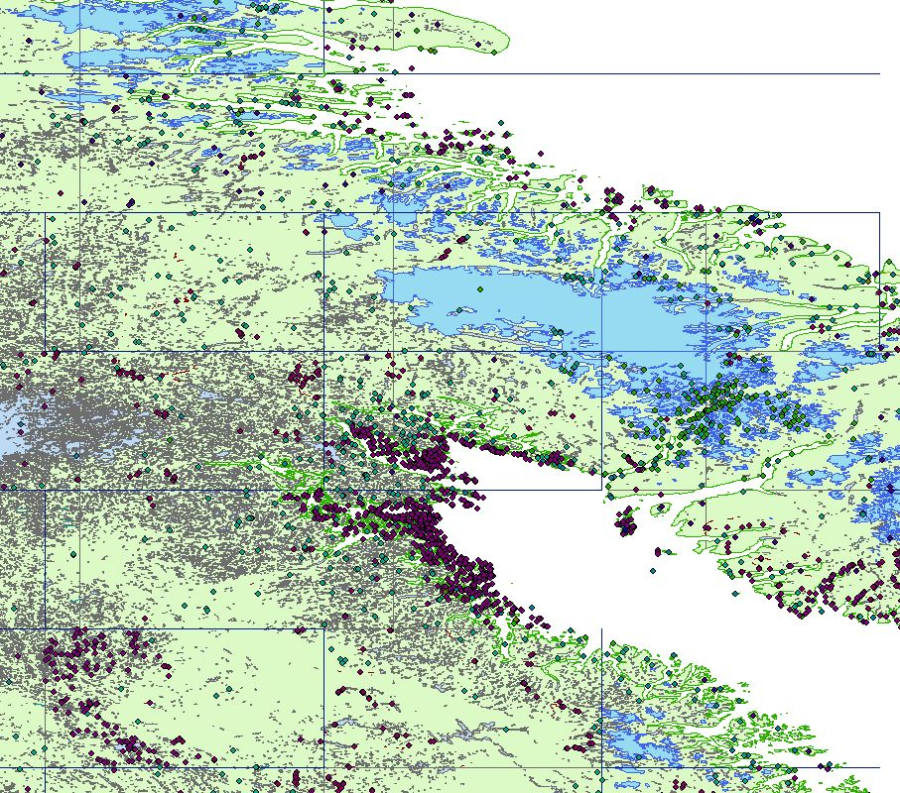
The VMap1 collection is a legacy product that is no longer supported. It may not meet current government standards. VMap1 is a vector digital topographic reference product developed by Natural Resources Canada (NRCan) and The Department of National Defence (DND). VMap1 complies with international military specifications vector map, level 1. There are 24 VMap1 libraries covering the Canadian territory. The National Topographic Data Base (NTDB) at scale of 1:250 000 is the main source used to populate the Canadian VMap1 Libraries. Administrative Boundaries from Statistics Canada are used to add international borders, provincial and Indian reserve limits. NRCan paper maps at scale of 1:250 000 and the information in the Canadian Geographical Names Data Base (CGNDB) are used to capture the names. The JOG (Joint Operations Graphic) paper maps were used by DND for the production of libraries 37, 38 and 66. Topographic features mainly from the NTDB have not been updated. VMap1 is published once and no product revision is planned.