 Arctic SDI catalogue
eDNA
Type of resources
Topics
Keywords
Contact for the resource
Provided by
Formats
Representation types
Update frequencies
status
-
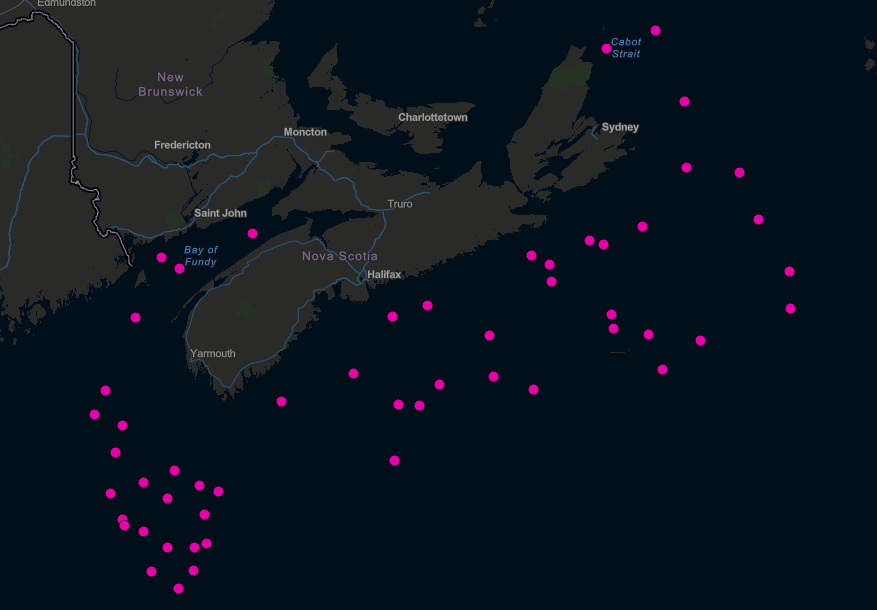
Marine Protected Areas require comprehensive monitoring to ensure objectives are achieved; however, monitoring natural ecosystems at scale is challenged by the biodiversity it aims to measure. Environmental DNA (eDNA) metabarcoding holds promise to address this monitoring challenge. We conducted paired sampling at 54 sites for fish and invertebrate assemblages in the Northwest Atlantic using groundfish trawls and eDNA metabarcoding of benthic seawater using four genetic markers (12S rRNA, 16S rRNA, 18S rRNA, and CO1). Compared to trawling, eDNA detected similar patterns of species turnover, larger estimates of gamma diversity, and smaller estimates of alpha diversity. A total of 63.6% (42/66) of fish species captured by trawling were detected by eDNA, along with an additional 26 species. Of the 24 missed detections by eDNA, 12 were inevitable as they lacked reference sequences. Excluding taxa assigned to higher than species level and those without a species name, 23.6% (17/72) of invertebrate species captured by trawling were detected by CO1, which detected an additional 98 species. We demonstrate that eDNA is capable of detecting patterns of community assemblage and species turnover in an offshore environment, emphasizing its strong potential for a non-invasive, comprehensive, and scalable tool for biodiversity monitoring supporting marine conservation programmes. Cite this data as: Jeffery, N., Rubidge, E., Abbott, C., Westfall, K., Stanley, R. (2024): Data of: eDNA metabarcoding enriches traditional trawl survey data for monitoring biodiversity in the marine environment. Published: August 2024. Coastal Ecosystems Science Division, Fisheries and Oceans Canada, Dartmouth, N.S. https://open.canada.ca/data/en/dataset/43a91ba7-8025-4330-88db-db14022d729d
-

Monitoring programs are an important component of Marine Protected Area (MPA) management, providing requisite information on the state of, and changes in, protected ecosystems. Monitoring is required to gauge the efficacy of MPAs towards their conservation objectives and provides information needed to evaluate the benefits provided to biodiversity from restricted access. However, in Nova Scotia’s coastal zone, there is a lack of baseline data, including fish diversity and community structure in macrophyte beds, which makes monitoring intractable. In 2017, the Eastern Shore Islands was identified as a coastal Area of Interest (AOI) for the potential establishment of an MPA. In 2018 an overview was conducted, detailing the spatial and temporal ecological attributes of the AOI. This information revealed a unique coastal ecosystem associated with a dense archipelago and relatively natural seascape. The abundance of plant and algal biogenic habitats within the area was assumed to host a diversity of juvenile fish species. The primary objective of this project is to begin development of a long-term biodiversity monitoring program in the Eastern Shore Islands and other coastal Areas of Interest for conservation planning. We propose implementing this program with the use of direct (beach seines, scuba diving, and stable isotope sampling) and indirect (environmental DNA - eDNA) sampling. Environmental DNA (eDNA) is a useful tool to examine marine biodiversity in a non-invasive way, on a small spatial scale. eDNA can be easily collected and filtered and is becoming increasingly cost efficient to sequence and may be a useful marine protected area monitoring tool. While eDNA generally yields comparable results to traditional sampling techniques in terms of biodiversity captured, little is known on how eDNA signals fluctuate across years (or even days to weeks). We will compare species detections using eDNA metabarcoding to visual surveys (scuba and seine nets) to census eelgrass beds across the coastal zone, providing a baseline and time series of species diversity on which to base long-term monitoring. This project will generate inventories of eelgrass bed locations, and fish and invertebrate diversity within eelgrass beds. We additionally collect fish length distribution data to examine seasonal and inter-annual trends in size structure over time. The data generated from direct and indirect sampling will provide a comprehensive and ongoing catalog of species diversity and community structure in coastal eelgrass beds, as well as best-practices for sampling eDNA in the coastal environment. Cite this data as: Jeffery, N.W., Pettitt-Wade, H., Van Wyngaarden, M., and Stanley, R.R.E. Maritimes Coastal Biodiversity Monitoring Program – Beach Seining. Published: December 2023. Coastal Ecosystems Science Division, Maritimes region, Fisheries and Oceans Canada, Dartmouth NS. https://open.canada.ca/data/en/dataset/dbbcb23a-d018-4b70-b8ec-89997aded770
-

To support the surveillance of key macroalgae and non-indigenous species in Nova Scotia and New Brunswick, five quantitative PCR (qPCR) assays were designed and tested at 111 sites in 2022-2023 targeting the following non-indigenous macroalgal species: Antithamnion sparsum, Bonnemaisonia hamifera, Codium fragile, Dasysiphonia japonica, Fucus serratus. All assays were developed in 2022 by the Center for Environmental Genomics Applications (CEGA, Newfoundland, Canada) except Antithamnion sparsum, for which an assay was developed in 2023 by the Aquatic Biotechnology Laboratory (ABL) at the Bedford Institute of Oceanography. All amplification was performed by the ABL in 2022-2023. The assay developed for Fucus serratus was later determined to be non-specific, and amplifies both F. serratus and Fucus distichus. Cite this data as: Krumhansl K, Brooks C, Lowen B, DiBacco C, (2025). Quantitative PCR (qPCR) of Key Macroalgal Non-Indigenous Species in Nova Scotia and New Brunswick Waters. Version 1.5. Fisheries and Oceans Canada. Samplingevent dataset. https://ipt.iobis.org/obiscanada/resource?r=quantitative_qpcr_macroalgal_nonindigenous_species_novascotia_newbrunswick_2022_2023&v=1.5 For additional information please see: LeBlanc F., Belliveau V., Watson E., Coomber C., Simard N., DiBacco C., Bernier R., Gagné N. 2020. Environment DNA (eDNA) detection of marine aquatic invasive species (AIS) in Eastern Canada using a targeted species-specific qPCR approach. Management of Biological Invasions 11(2):201-217 Krumhansl K.A., Brooks C.M., Lowen B., O’Brien J., Wong M., DiBacco C. Loss, resilience and recovery of kelp forests in a region of rapid ocean warming. Annals of Botany 2024 Mar 8; 133(1):73-92 Brooks C.M., Krumhansl K.A. 2023. First record of the Asian Antithamnion sparsum Tokida, 1932 (Ceramiales, Rhodophyta) in Nova Scotia, Canada. BioInvasions Records 12(3):745-725.
-
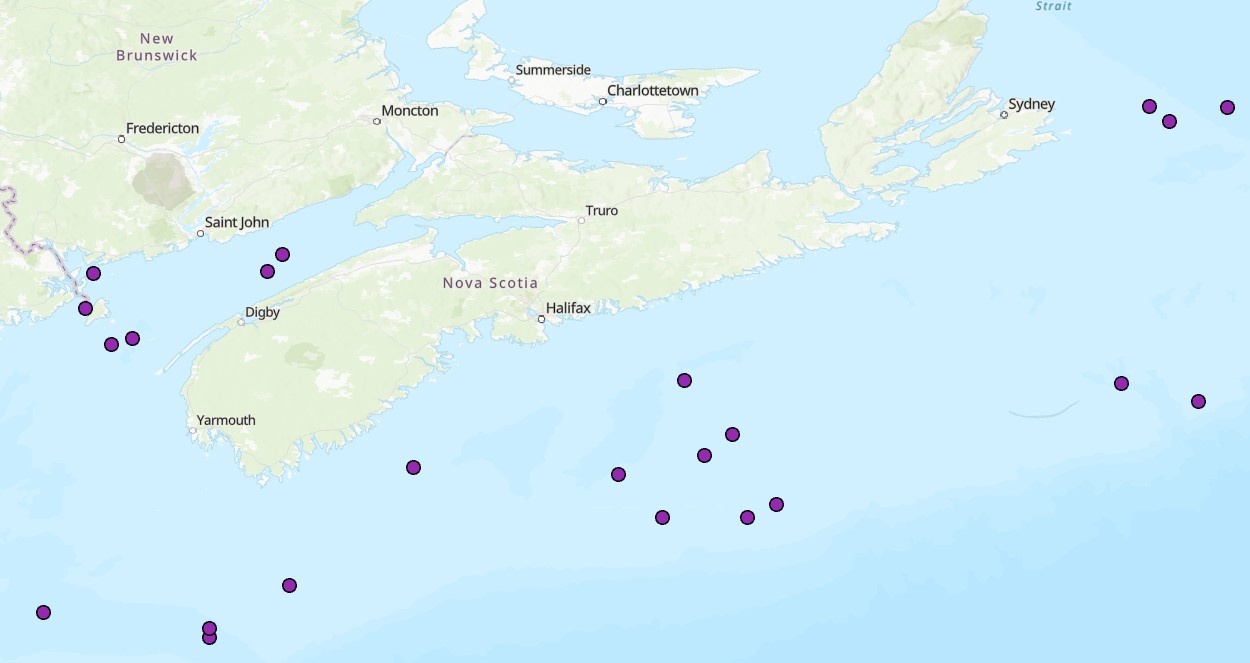
DFO has committed to establishing a representative network of Marine Conservation Areas collectively comprising 30% of the EEZ by 2030. The MCT 2.0 program was established in 2021 to help achieve this target and establish long-term monitoring within Canadian conservation areas. Information on the distribution of species within a protected area is essential for the management and monitoring of a site. Decisions made on zoning, risk assessment, activity approvals and management effectiveness all require information on the distribution and status of species. The Scotian Shelf-Bay of Fundy Bioregion spans the domain of the Maritimes Region, and within it there are 8 Marine Refuges (MR), 3 Marine Protected Areas (MPA), and 2 Areas of Interest (AOI). Environmental DNA (eDNA) offers a promising approach for biodiversity monitoring that has been gaining increased attention in the marine realm. Through sampling relatively small volumes of water (~3L), eDNA can capture of millions of fragments of eDNA on specialized filters that can then be sequenced to identify the species composition of an area. eDNA metabarcoding is based on the foundations of DNA barcoding, where species are identified solely by their unique DNA sequences. This method is relatively simple, efficient (with the ability to characterize both fish and invertebrate diversity), and non-invasive, meaning there is no disruption of sensitive benthic habitats or need to dissect tissue samples from captured fish and invertebrates. eDNA has been shown to be comparable to other biodiversity censusing techniques and has the potential to rapidly conduct biodiversity surveys over a relatively large area, such as the Eastern Shore Islands AOI. The DFO Maritimes summer multispecies trawl survey is one of the longest-running data series with applications in fisheries stock assessment, and one of the only sources of data for offshore MPA design and monitoring. In this project we pair eDNA samples collected within current and proposed conservation areas with trawl catch data to create a biodiversity and animal community monitoring time series for these areas. We use eDNA and trawl catch data as complementary tools, where trawl-based catch provides information on fish abundance, size distributions and sex, and eDNA provides information on genetic diversity and can detect cryptic and rare species. Cite this data as: Jeffery, N.W. Monitoring regional conservation areas using paired environmental DNA and research trawl surveys. Published: May 2026. Coastal Ecosystems Science Division, Maritimes Region, Fisheries and Oceans Canada, Dartmouth NS.