 Arctic SDI catalogue
Northern Canada
Type of resources
Available actions
Topics
Keywords
Contact for the resource
Provided by
Formats
Representation types
Update frequencies
status
-

Map shows the geography of the northern circumpolar region, north of approximately 55 degrees latitude. This product is derived from the Atlas of Canada's bilingual wall map "The Circumpolar Region - North" (MCR 0001). To limit the impact of aliasing of the annotation we rendered the map into two tiled web services with a service showing the 'base' information and the other the 'annotation.' Combined the two services more or less replicate the wall map online. In addition to the tiled services, the mxd and geodatabase in FGDB format are available for download. Note: Since the geodatabase was derived from a cartographic product not all features have attribute information even though they are labelled on the map. The map uses the azimuthal equidistant projection. Displayed on the map are the international boundaries, as well as the Canadian provincial and territorial boundaries, all current to 2014. Also shown are national capital cities, other cities, towns, villages and hamlets along with some seasonally populated places. The map identifies a number of significant northern features, including the median sea ice extent from September 1981 to 2010, the tree line, undersea relief, land relief, glaciers, ice fields and coastal ice shelves. Labelled are many of the physiographic and hydrographic features.
-

This dataset contains point distribution occurrences for fish species found in marine waters of Arctic Canada. It was used to create the distribution maps in the book Marine Fishes of Arctic Canada, edited by B.W. Coad and J.D. Reist (2018) and the DFO Data Report of Fisheries and Aquatic Sciences Distributional Records for Marine Fishes of Arctic Canada (Alfonso et al. 2018). The database includes literature (Coad and Reist 2016) and museum records, anecdotal reports, personal communications and data from fisheries surveys and exploratory cruises. Development of the database began in 1998 and data entry ceased in 2016, although the database will be updated periodically. Consult the book (Coad and Reist 2018) and the Data Report (Alfonso et al. 2018) for further details in regards to the specific sources for each data point by species especially those from sources other than published literature.
-
PURPOSE: "Biological, relative abundance, and environmental data have been collected from the Yellowknife River Cisco population that can be used to inform fisheries management decision-making. Under the conditions of a commercial licence issued under the New Emerging Fisheries Policy, licence holders are required to record catch and biological information to support the assessment of the feasibility and sustainability of the fishery over time, and potential advancement in the stages of a developing fishery. In addition to the information collected from the commercial harvest (fishery-dependent), a fishery-independent sampling and snorkel survey program was conducted with the objective of collecting additional biological, observational, and environmental data during the fall spawning run. The objective of this report is to compile available data from fishery-dependent and fishery-independent sampling of adfluvial Yellowknife River Cisco during fall, 1998-2020*, specifically by: • Summarizing commercial fishery quotas and reported harvest; • Characterizing population demographics and examining for trends over time; • Summarizing metrics of relative abundance (i.e., catch-per-unit-effort data and snorkel survey observations) and examining for trends over time; and • Determining if there were any associations between relative abundance of Cisco and river discharge and temperature. *A commercial harvest occurred in 1998, although no biological or catch-effort records were located. In addition, in response to concerns about the status of the population, the fishery was put on hold 2006–2009 to allow for a population assessment (no data during that time). DESCRIPTION: Cisco (Coregonus artedi) from the Yellowknife River, Northwest Territories, are an important fishery resource for nearby communities. Biological, catch-effort, and environmental data were collected from the Yellowknife River (Tartan Rapids and Bluefish areas) during their fall spawning run from Great Slave Lake. Data from the commercial harvest (fishery-dependent; 1998–2020) and supplementary monitoring (fishery-independent; 2013–2020) of these adfluvial Cisco were compiled to summarize commercial fishery quotas and reported harvest, characterize population demographics and catch-effort over time, and assess potential associations between relative abundance and seasonal river characteristics. A single commercial fishing licence for Cisco was issued on an annual basis each fall for 1,000 kg from 1998–2002, 2,000 kg from 2004–2005, 1,000 kg from 2010–2018, and 1,500 kg from 2019–2020. Cisco ranged from 102–239 mm fork length, 10.0–139.6 g round weight, and 1 and 9 years of age, with the majority of fish (>99%) being sexually mature. The demographics (length, weight, age) of the spawning population collected from the commercial fishery remained relatively stable between 1999 and 2020. Catch-effort of the commercial fishery varied widely among years without trend, although this was not standardized to the number of individuals/nets used to capture the fish. The biological, catch-effort, and environmental data collected from the Yellowknife River spawning population of Cisco serve as a benchmark for their ongoing assessment and management.
-
Great Slave Lake in the Northwest Territories is one of the most important areas for inland breeding gulls and terns (larids) in northern Canada. Numerous rocky islands on the North Arm provide breeding habitat for a number of colonially-nesting larid species. Great Slave Lake is the only known breeding site for Caspian Terns in the Northwest Territories and the North Arm is the northernmost known breeding range for the species in North America. Given its importance to a variety of migrating, nesting and staging birds, various portions of the area have been recognized as; a Key Migratory Bird Terrestrial Habitat site, an Important Bird Area, and an International Biological Program site. This dataset contains results from surveys of active larid breeding colonies from between 1986 and 2010 on the portion of the North Arm west of Yellowknife. Most data were collected through ground surveys, with travel by boat, between mid June to early July. Information recorded at each colony included species, numbers of nests, clutch size, presence of chicks, and habitat characteristics (vegetation cover). The majority of larid colonies were located on islands along the northeastern shoreline. The southwest shoreline saw limited use by nesting larids due to the reduced number and different characteristics of the islands in that area. The most regularly occurring species were Herring Gull, Mew Gull, Ring-billed Gull, California Gull, Common Tern, Arctic Tern, and Caspian Tern. Results of these surveys have been published in the report “Gull and Tern Breeding Colonies on the North Arm of Great Slave Lake, Northwest Territories: 1986-2010 (Woodard, Fournier, and Robertson, 2013). Woodard, P.F., M.A. Fournier, and M.O. Wiebe Robertson. 2013. Gull and Tern Breeding Colonies on the North Arm of Great Slave Lake, Northwest Territories: 1986-2010. Technical Report Series No. 526, Canadian Wildlife Service, Yellowknife, NT. More details are available in the metadata document for download. CWS-North DatasetID: 071_0
-

This 4th edition Plant Hardiness Zones map shows updated zones related to perennial plant survival in Canada. The map is based on a formula using seven climate variables that influence plant survival: 1. Monthly mean of the daily minimum temperatures of the coldest month. 2. Mean frost-free period above 0°C in days. 3. Amount of rainfall from June to November. 4. Monthly mean of the daily maximum temperatures of the warmest month. 5. A winter harshness index related to rainfall in January. 6. Mean maximum snow depth. 7. Maximum wind gust in 30 year period. The original map was developed by Agriculture and Agri-Food Canada in the early 1960s based on average climate values from 1930 to 1960. This new map uses 1991 to 2020 averages. The map shown to the left of this map shows an alternative plant hardiness zone approach using just one climate variable: average extreme minimum temperature for the period 1991 to 2020. This was originally developed by scientists at the United States Department of Agriculture (see https://www.usna.usda.gov/science/plant-hardiness-zone-map/). The development of these maps was made possible through a collaborative effort by scientists at Natural Resources Canada’s Canadian Forest Service, Environment Canada, and Agriculture and Agri-Food Canada. A paper describing the research, “Updated plant hardiness zones for Canada and assessment of change over time”, can be found in Scientific Reports, Vol. 15(1), 22774 ( https://doi.org/10.1038/s41598-025-00931-5).These maps were produced by the Canada Centre for Mapping and Earth Observation, Natural Resources Canada. To view an interactive version of this map and for more information on plant hardiness zones in Canada, please go to: https://www.planthardiness.gc.ca.
-
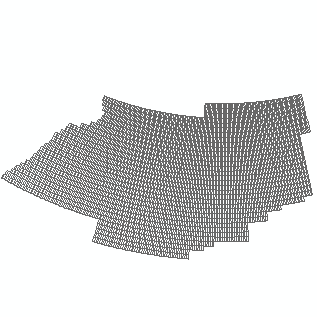
The High Arctic dataset comes from the Petroleum and Environmental Management Tool (PEMT). The online tool was decommissioned in 2019 and the data was transferred to Open Data in order to preserve it. The PEMT was originally developed in 2009 to help guide development in the Canadian Arctic by Indian and Northern Affairs Canada (INAC). The online tool mapped the sensitivities of a variety of Arctic features, ranging from whales to traditional harvesting, across the Arctic. The tool was intended to aid government, oil and gas companies, Aboriginal groups, resource managers and public stakeholders in better understanding the geographic distribution of areas which are sensitive for environmental and socio-economic reasons. The study area is located in the High Arctic Archipelago and contains both marine and terrestrial components. The boundaries of the study area are based on the NOGB leasing grids applied in the High Arctic, under which exploration, significant discovery and production licenses may be issued. The Sverdrup Basin (and Lancaster Sound) has the highest known oil and gas potential of the sedimentary basins of the Arctic Islands (Nunavut Planning Commission 2000) and it is expected that there is oil and gas potential on Melville Island and Bathurst Island (Sivummut Economic Development Strategy Group 2003). To date, no gas has been produced, and 321,470 m³ of oil has been produced from the Bent Horn oil field (Morrell et al. 1995). DISCLAIMER: Please refer to the PEMT Disclaimer document or the Resource Constraints - Use Limitation in the Additional Information section below. Note: This is one of the 3 (three) datasets included in the PEMT application which includes the Beaufort Sea and Mackenzie Delta and Eastern Arctic datasets.
-
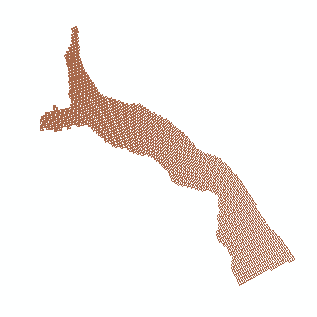
The Eastern Arctic dataset comes from the Petroleum and Environmental Management Tool (PEMT). The online tool was decommissioned in 2019 and the data was transferred to Open Data in order to preserve it. The PEMT was originally developed in 2009 to help guide development in the Canadian Arctic by Indian and Northern Affairs Canada (INAC). The online tool mapped the sensitivities of a variety of Arctic features, ranging from whales to traditional harvesting, across the Arctic. The tool was intended to aid government, oil and gas companies, Aboriginal groups, resource managers and public stakeholders in better understanding the geographic distribution of areas which are sensitive for environmental and socio-economic reasons. The study area is located east of Baffin Island, Nunavut and encompasses marine habitat in Baffin Bay and Davis Strait. The boundaries of the study area are based on NOGB leasing grids applied in the Eastern Arctic, under which exploration and production licenses may be issued. Although portions of the study area hold high oil and gas potential and several small oil fields and substantial reserves of gas have been found since the 1960s in the north Baffin region, exploration for oil and gas has been limited to seismic operations and geological field work. DISCLAIMER: Please refer to the PEMT Disclaimer document or the Resource Constraints - Use Limitation in the Additional Information section below. Note: This is one of the 3 (three) datasets included in the PEMT application which includes the Beaufort Sea and Mackenzie Delta and High Arctic datasets.
-
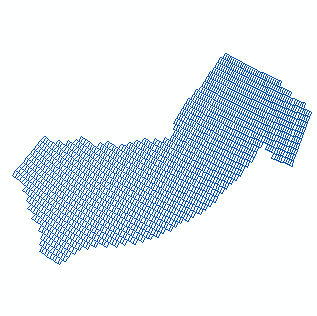
The Beaufort Sea and Mackenzie Delta dataset comes from the Petroleum and Environmental Management Tool (PEMT). The online tool was decommissioned in 2019 and the data was transferred to Open Data in order to preserve it. The PEMT was originally developed in 2009 to help guide development in the Canadian Arctic by Indian and Northern Affairs Canada (INAC). The online tool mapped the sensitivities of a variety of Arctic features, ranging from whales to traditional harvesting, across the Arctic. The tool was intended to aid government, oil and gas companies, Aboriginal groups, resource managers and public stakeholders in better understanding the geographic distribution of areas which are sensitive for environmental and socio-economic reasons. The study area and analytical resolution was defined using the oil and gas leasing grid within the Beaufort Sea. The study area has been the scene of oil and gas exploration activity since 1957. Oil was first discovered at Atkinson Point in 1969 and major gas fields in the early 1970s. Such finds spurred the proposal of the Mackenzie Valley Pipeline in 1974 and the addition of exploration and investment offshore. Exploration and drilling continued both onshore and offshore until the mid-1970s with the release of the Berger Report, which recommended a 10-year moratorium on the construction of the pipeline. After the release of the Berger Report, the pace of onshore activity declined but offshore exploration escalated in the 1980s. Offshore exploration was facilitated with innovative operating techniques and new offshore platforms that extended the ability to operate in the short open-water season and ice. With the minor exception of the small onshore gas field at Ikhil, no oil or gas has been commercially produced in the area. DISCLAIMER: Please refer to the PEMT Disclaimer document or the Resource Constraints - Use Limitation in the Additional Information section below. Note: This is one of the 3 (three) datasets included in the PEMT application which includes the High Arctic and Eastern Arctic datasets.
-
In 2022, the federal government launched the second phase of the Oceans Protection Plan, a vast interdepartmental program designed to enhance marine safety in Canada by improving our ability to prevent and respond to marine incidents. For the Canadian Wildlife Service (CWS) of Environment and Climate Change Canada (ECCC), this means filling gaps in our knowledge of marine and coastal bird species. In order to identify these gaps for the province of Quebec, we carried out a prioritization exercise in 2022. We concluded that major efforts needed to be made in the Nunavik marine region, since data were lacking in several sectors and for several species. Understanding the vulnerability of wildlife species over time and space will help us, among other things, to assess risks and act quickly and appropriately in the event of incidents affecting the marine environment, such as an oil spill or shipwreck. Another important objective of the Oceans Protection Plan is to implement sustainable partnerships with the Inuit in order to share our respective knowledge of migratory birds, develop joint projects and support Inuit-led marine bird projects. It is in this context that aerial inventories aimed at identifying avian diversity, counting seabirds and coastal birds and better understanding their distribution at different times of the year have been taking place in Nunavik since 2023. These inventories are particularly aimed at sites of large gatherings, such as molting and staging areas, where birds are more vulnerable. During flights, the crew scans the sea, bays, river mouths and coasts for single birds or groups of birds. When birds are spotted, the number of individuals is estimated and a formal identification is made to the most precise taxonomic level possible, usually species or genus. In some cases, particularly for species that are more difficult to identify or in the case of very large groups, high-resolution photographs are taken to confirm identifications and estimates of the number of individuals a posteriori. Where possible, individuals are identified by age and sex. For the purposes of these inventories, flight-capable birds are considered adults unless immature plumage is easily identifiable from a moving aircraft. Thus, most ducks, as well as shorebirds, are considered adults as soon as they are able to fly. Occasionally, the aircraft lands on the ground for short periods to allow the team to refine the identification of the species, genus and age of the birds. These observations are then included in the database. Observations made over land, during various trips, are also recorded opportunistically. Source to quote : Canadian Wildlife Service - Quebec Region. Aerial surveys of marine and coastal birds in Nunavik. Data collected as part of the Oceans Protection Plan. Version October 2025.
-
In 2022, the federal government launched the second phase of the Oceans Protection Plan, a vast interdepartmental program designed to enhance marine safety in Canada by improving our ability to prevent and respond to marine incidents. For the Canadian Wildlife Service (CWS) of Environment and Climate Change Canada (ECCC), this means filling gaps in our knowledge of marine and coastal bird species. In order to identify these gaps for the province of Quebec, we carried out a prioritization exercise in 2022 and concluded that major efforts needed to be made in the Nunavik marine region, since data were lacking in several sectors and for several species. Understanding the vulnerability of wildlife species over time and space will help us, among other things, to assess risks and act quickly and appropriately in the event of incidents affecting the marine environment, such as an oil spill or shipwreck. Another important objective of the Oceans Protection Plan is to implement sustainable partnerships with the Inuit in order to share our respective knowledge of migratory birds, develop joint projects and support Inuit-led marine bird projects. It is in this context that ground surveys of marine bird nests on the islands of Nunavik are being carried out by the CWS, in collaboration with Nunavimmiut. The main objective of these surveys is to update available data on the abundance and distribution of nesting seabirds in this area, particularly Common Eiders (Somateria mollissima). On each island visited, a team follows transects distributed from one end to the other and across the entire width of the island, in order to obtain complete and systematic coverage of the island and to count all the nests present. The spacing between transects can vary according to the size of the island, its topography and the density of nests present. This database provides access to the survey results and shows, for each island surveyed, the number of nests of each species present. In the case of the Black Guillemot (Cepphus grylle), since nests are very difficult to find, it is rather the number of adults present around the island that is reported. Finally, in some cases, notably for gulls (Larus spp.), if no nests were found, but adults were observed on or around the island, then a number of adult individuals was reported.