 Arctic SDI catalogue

infostats@statcan.gc.ca
Type of resources
Available actions
Topics
Keywords
Contact for the resource
Provided by
Formats
Representation types
Update frequencies
status
-

The 2025 Census Subdivision Boundary File depicts the boundaries of all 5,054 census subdivisions, which combined, cover all of Canada. It contains the unique identifier (UID), name and type, as well as the UIDs, names and types (where applicable) of selected higher geographic levels. The 2025 Census Subdivision Boundary File is portrayed in Lambert conformal conic projection (North American Datum of 1983 [NAD83]) and is available as a national file.
-
The 2023 Census Subdivision Boundary File depicts the boundaries of all 5,173 census subdivisions (CSDs), which combined, cover all of Canada. It contains the unique identifier (UID), name and type, as well as the UIDs, names and types (where applicable) of selected higher geographic levels. The 2023 Census Subdivision Boundary File is portrayed in Lambert conformal conic projection (North American Datum of 1983 [NAD83]). The 2023 Census Subdivision Boundary File is available as a national file.
-

This service shows the median total income of households in 2015 for Canada by 2016 census subdivision. The data is from the Census Profile, Statistics Canada Catalogue no. 98-316-X2016001. Total income refers to the sum of certain incomes (in cash and, in some circumstances, in kind) of the statistical unit during a specified reference period. The median income of a specified group is the amount that divides the income distribution of that group into two halves. For additional information refer to 'Total income' in the 2016 Census Dictionary. For additional information refer to 'Total income' in the 2016 Census Dictionary. To have a cartographic representation of the ecumene with this socio-economic indicator, it is recommended to add as the first layer, the “NRCan - 2016 population ecumene by census subdivision” web service, accessible in the data resources section below.
-
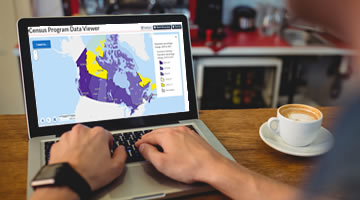
The Census Program Data Viewer (CPDV) is an advanced web-based data visualization tool that helps make statistical information more interpretable by presenting key indicators in a statistical dashboard. It also enables users to easily compare indicator values and identify relationships between indicators.
-

Here is a selection of map services from Statistics Canada displaying socio-economic variables as thematic maps, viewed by census subdivision. This selection covers the following themes: families and households, housing, education, language, income, immigration, aboriginal people, age and transport. Census subdivision (CSD) is the general term for municipalities (as determined by provincial/territorial legislation) or areas treated as municipal equivalents for statistical purposes (e.g., Indian reserves, Indian settlements and unorganized territories). Municipal status is defined by laws in effect in each province and territory in Canada. NOTE: Services by theme may not all be listed in the Related Products section below as they are added individually only once available for publication.
-

The 2022 Road Network File depicts the digital road line coverage for Canada. It contains information such as street arc unique identifier (UID), name, type, direction and address range, as well as rank and class. It also includes province or territory (PR) and census subdivision (CSD) information for each side of a street arc (where applicable).The Road Network File is portrayed in Lambert conformal conic projection (North American Datum of 1983 [NAD83]). The 2022 Road Network File is available as a national file.
-

GeoSuite is a tool used for data retrieval, query and tabular output. It allows users to explore the links between all standard levels of geography and to identify geographic codes, names, unique identifiers, and, where applicable, types, as well as land area and population and dwelling counts. GeoSuite includes data for the following the 2021 Census standard geographic areas: • Canada (CAN) • Provinces and territories (PRs) • Census divisions (CDs) • Federal electoral districts (FEDs) (2013 Representation Order) • Census subdivisions (CSDs) • Designated places (DPLs) • Economic regions (ERs) • Census consolidated subdivisions (CCSs) • Census metropolitan areas (CMAs), census agglomerations (CAs) and census metropolitan influenced zones (MIZs) • Census tracts (CTs) • Population centres (POPCTRs) and rural areas (RAs) • Dissemination areas (DAs) • Dissemination blocks (DBs) • Aggregate dissemination areas (ADAs) • Place names (PNs)
-
The 2021 Census Boundary Files depict the boundaries of all standard geographic areas established for the purpose of disseminating census data. They contain information such as unique identifier (UID), name and type where applicable, as well as land area and province or territory unique identifier (PRUID). Each boundary file can be linked to all higher level geographic areas using its DGUID and the new 2021 Dissemination Geographies Relationship File. They are available for download or viewing in two types: cartographic and digital. Both cartographic and digital boundary files are portrayed in Lambert conformal conic projection (North American Datum of 1983 [NAD83]). The purpose of the 2021 Census Boundary Files is to provide a framework for mapping and spatial analysis, and to support Geographic Information System (GIS) applications used for land use and demographic studies, or social, economic and market research. Geographic unique identifiers permit linkage of statistical data to geographic areas depicted in the boundary files. Boundary files can also be used to create new geographic areas by combining standard geographic areas. The boundary files are positionally consistent with the 2021 Road Network File, which provides additional reference for geographic context for mapping applications. Each 2021 Census Boundary File contains the UID, DGUID, name and type where applicable, and land area of the geographic level the file represents. It also contains the PRUID. A 2021 Census Boundary File is available for each of the following geographic areas: • Provinces and territories (PRs) • Census divisions (CDs) • Federal electoral districts (2013 Representation Order) (FEDs) • Census subdivisions (CSDs) • Designated places (DPLs) • Economic regions (ERs) • Census agricultural regions (CARs) • Census consolidated subdivisions (CCSs) • Census metropolitan areas and census agglomerations (CMA/CAs) • Census tracts (CTs) • Population centres (POPCTRs) • Dissemination areas (DAs) • Dissemination blocks (DBs) • Aggregate dissemination areas (ADAs) • Census Forward Sortation Areas© (CFSAs©) • Population Ecumene
-
The 2025 Road Network File depicts the digital road line coverage for Canada. It contains information such as street arc unique identifier (UID), name, type, direction and address range, as well as rank and class. It also includes province or territory (PR) and census subdivision (CSD) information for each side of a street arc (where applicable). The Road Network File is portrayed in Lambert conformal conic projection (North American Datum of 1983 [NAD83]) and is available as a national file.
-

Reference maps illustrate the location of census standard geographic areas for which census statistical data are tabulated and disseminated. The maps display the boundaries, names and unique identifiers of standard geographic areas, as well as physical features such as streets, railroads, coastlines, rivers and lakes. Reference maps include: Standard Geographical Classification (SGC) Census tracts Federal electoral districts