 Arctic SDI catalogue
Invasive species
Type of resources
Categories
Available actions
Topics
Keywords
Contact for the resource
Provided by
Formats
Representation types
Update frequencies
status
-

Aquatic invasive species pose economic and ecological threats to Canada's coastal waters. In response, Fisheries and Oceans Canada (DFO) has established monitoring programs to detect and track the spread of aquatic invasive species, including European Green Crab, in Canadian waters. Fukui traps have been deployed annually at both new and long-term monitoring locations throughout coastal British Columbia.
-

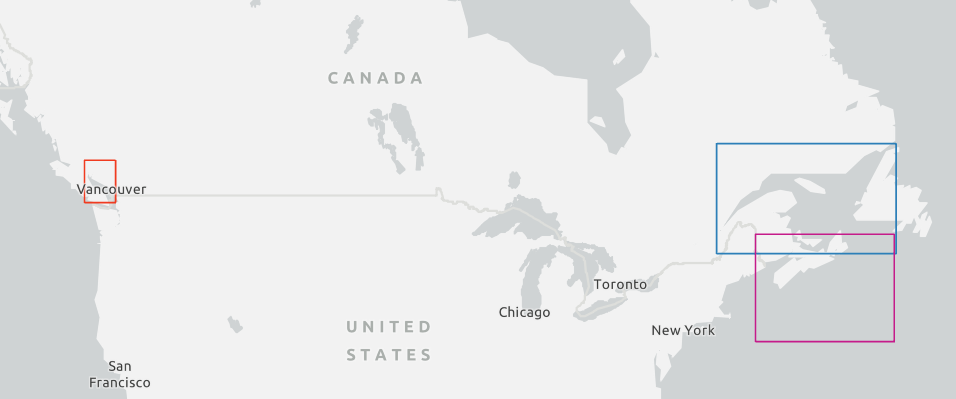
Since 2005, Fisheries and Oceans Canada has been collecting monitoring data for aquatic invasive species (e.g. https://open.canada.ca/data/en/dataset/8d87f574-0661-40a0-822f-e9eabc35780d, https://open.canada.ca/data/en/dataset/503a957e-7d6b-11e9-aef3-f48c505b2a29, https://open.canada.ca/data/en/dataset/8661edcf-f525-4758-a051-cb3fc8c74423). This monitoring data, as well additional occurrence information from online databases and the scientific literature, have been paired with high resolution environmental data and oceanographic models in species distribution models that predict the present-day and future potential distributions of 12 moderate to high risk invasive species on Canada’s east and west coasts. Future distributions were predicted for 2075, under Representative Concentration Pathway 8.5 from the Intergovernmental Panel on Climate Change’s fifth Assessment Report. Present-day and future richness of these species (i.e., hotspots) has also been estimated by summing their occurrence probabilities. This data set includes the occurrence locations of each species, the present-day and future species distribution modeling results for each species, and the estimated species richness. This research has been published in the scientific literature(Lyons et al. 2020). Lyons DA, Lowen JB, Therriault TW, Brickman D, Guo L, Moore AM, Peña MA, Wang Z, DiBacco C. (In Press) Identifying Marine Invasion Hotspots Using Stacked Species Distribution Models. Biological Invasions Cite this data as: Lyons DA., Lowen JB, Therriault TW., Brickman D., Guo L., Moore AM., Peña MA., Wang Z., DiBacco C. Data of: Species distribution models and occurrence data for marine invasive species hotspot identification. Published: November 2020. Coastal Ecosystems Science Division, Fisheries and Oceans Canada, Dartmouth, N.S. https://open.canada.ca/data/en/dataset/1bbd5131-8b34-4245-b999-3b4c4259d74f
-

This data is intended to identify Canadian Alternate Exchange Areas described in https://tc.canada.ca/en/marine-transportation/marine-safety/list-canada-s-designated-alternate-ballast-water-exchange-area-fresh-waters-tp-13617e-2021. The data is not intended for navigation purposes. According to Canada’s Ballast Water Regulations, if your vessel enters waters under Canadian jurisdiction from somewhere other than the U.S. waters within the Great Lakes Basin, and it cannot conduct a ballast water exchange in the areas set out in paragraphs 14(1)(a) and (b) of the regulations, then it will have to conduct a ballast water exchange in one of the areas listed below: -Gulf of St. Lawrence -Atlantic Canada-Western Canada -Canadian Eastern Arctic -Canadian Western Arctic: If you bring your vessel to a Canadian port, offshore terminal or anchorage area in the Western Arctic ballast water must be exchanged in an area as far away from shore as possible, where the water is more than 100 meters deep. Legal Constraints: Users should be aware that the polygons depicting ballast water exchange areas are intended for illustration only and should not be used for navigational or legal purposes.
-
Historical finds of Pristiphora erichsonii
-
CMIST is a peer-reviewed screening-level risk assessment tool for marine invasive species (Drolet et al. 2016). It is a short questionnaire that follows the invasion process from arrival to impact and is designed so an informed assessor can evaluate one species in an assessment area in approximately one day using easily accessible information from internet databases, primary literature, and grey literature. Species can be those with an invasion history in an area or those that are candidates for future invasions. CMIST is score-based and incorporates both likelihood and impact of invasion as well as uncertainty. Questions are general to make CMIST broadly applicable to different taxa, different assessment areas, and different project goals. To date, CMIST has been tested with molluscs, tunicates, crustaceans, and polychaetes introduced or at risk of introduction to three Canadian marine ecoregions (DFO 2009). CMIST has also been successfully applied to non-indigenous freshwater fish in British Columbia with adapted guidelines (T. Therriault, pers. comm.). Upon completion, CMIST produces a risk score adjusted for the assessor’s uncertainty which, combined with information collected during the assessment, can be used to assist in management decisions. For example, in 2015, CMIST assessments were used to identify high risk invaders in three Canadian marine ecoregions (DFO 2016).
-
Historical finds of Profenusa thomsoni
-
Historical finds of Pristiphora geniculata
-
Historical finds of Coleophora laricella
-
Historical finds of Operophtera brumata
-
Historical finds of Fenusa pumila