 Arctic SDI catalogue
marine
Type of resources
Categories
Available actions
Topics
Keywords
Contact for the resource
Provided by
Years
Formats
Representation types
Update frequencies
status
Service types
-
In the Marine Strategy Framework Directive (MSFD), four marine regions are listed (art. 4). The North-east Atlantic Ocean and Mediterranean Sea marine regions are both further divided into four subregions. The marine regions and subregions include: The Baltic SeaThe North-east Atlantic OceanThe Greater North Sea, including the Kattegat and the English ChannelThe Celtic SeasThe Bay of Biscay and the Iberian CoastMacaronesiaThe Mediterranean SeaThe Western Mediterranean SeaThe Adriatic SeaThe Ionian Sea and the Central Mediterranean SeaThe Aegean-Levantine SeaThe Black SeaThis map has been developed to support DG Environment and EU Member States in their implementation of the MSFD. It represents the current state of understanding of the marine regions and subregions and is subject to amendment in light of any new information which may be received.The primary aim of this map is the geometric delineation of the marine regions and subregions. The secondary aim is to establish a common understanding of marine boundaries and thus aid the streamlining of obligations under EU legislation, e.g. coordination between Member States, work establishment of monitoring programmes, establishment of programmes of measures, EEA indicator and assessment efforts and ‘Research and Technological Development’ (RTD) initiatives to be as relevant as possible for policy processes aiming at implementing an ecosystem-based approach to management. Lastly, the map can aid the harmonization between regions as required under other EU legislation and policies, by Regional Sea Conventions, International Council for the Exploration of the Sea (ICES) Ecoregions and other regional delineations. The aim is not to pre-empt any official discussions on maritime boundaries under UNCLOS.The delineation has been developed since 2010 based on multiple inputs from Member State representatives participating in groups defined under the MSFD Common Implementation Strategy, reporting under the MSFD Initial Assessment, ICES advice and Marine Regions. The process has especially been developed under the MSFD CIS Working Group on Data, Information and Knowledge Exchange (WGDIKE) through documents DIKE 3/2011/06 from 5-6thSeptember 2011, DIKE 4/2011/05 from 7-8thNovember 2011, DIKE 5/2012/08 from 12-13thMarch 2012, DIKE TG1/2012/04 from 4thJuly 2012 and, lastly, DIKE 6/2012/11 from 30-31th October 2012. Since then it has been developed through cooperation between DG ENV, EEA and the ETC-ICM (via ICES as an ETC-ICM partner) and a consultation with Member States in 2015. The map has also been through a Commission inter-service consultation with all DG’s led by DG ENV. It wasfinallyadopted by EU Member States in the MSFD Committee in November 2016. The boundaries between marine regions and subregions have, to the extent possible, been harmonised with existing boundaries established under the Regional Sea Conventions, the biogeographic boundaries established under the Habitats Directive and the boundaries of marine waters reported by EU Member States under the MSFD. The ICES ecoregions are being aligned with the MSFD region and subregion boundaries.The inner boundary of all regions and subregions has used the “EEA coastline for analysis” available at (http://www.eea.europa.eu/data-and-maps/data/eea-coastline-for-analysis/); this is a practical solution because the MSFD inner boundary formally follows that defined for coastal waters under the Water Framework Directive, for which a consistent boundary is not yet available.For delineating subregions in the North-east Atlantic Ocean region, information on Member States' marine waters, where Member States have and/or exercise jurisdictional rights, has been used, based on submissions of the marine waters under the MSFD when these have been made available by the individual Member States as part of their 2012 reporting.Regarding the map symbology, the following notes have to be taken into account:Note 1:The area shaded in purple and white indicates an area to which both the United Kingdom and the Government of the Kingdom of Denmark together with the Government of the Faroes have transmitted overlapping submissions to the Commission on the Limits of the Continental Shelf (CLCS) in fulfilment of their respective rights and obligations under Article 76 and Annex II to the United Nations Convention on the Law of the Sea in order to determine entitlement of outer continental shelf areas. This map should not be used in any way to prejudice the determination of that question by the CLCS in due course.Note 2:The area shaded in black and white shows the delineation of the outer limits of the continental shelf beyond 200 M from the territorial sea baselines of France, Ireland, Spain and the United Kingdom in respect of the area of the Celtic Sea and the Bay of Biscay, as provided by the four countries to the Commission on the Limits of the Continental Shelf (CLCS) and included in its recommendations issued on 24 March 2009. The map of the continental shelf’s extent shall be used without prejudice to the agreements that will be concluded in due course between these Member States on their marine borders in this area.Note 3: The seas of Azov and Marmara are shown as shaded as they do not fall within the geographic scope of application of the Bucharest Convention.The link to the layers, as well as the document describingthe geometric delineation of the marine regions and subregionsandthe process that led to an agreement on the boundaries areavailable at the following link: http://www.eea.europa.eu/data-and-maps/data/msfd-regions-and-subregions
-

The locations of coastal British Columbia moorages. The Coastal BC datasets are circa 2004 and legacy in nature. Caution should be exercised when using this data, as it may not be accurate or complete. There are currently no plans to update.
-
The location of coastal British Columbia marine kayaking point features, such as destinations and overnight campsites. The Coastal BC datasets are circa 2004 and legacy in nature. Caution should be exercised when using this data, as it may not be accurate or complete. There are currently no plans to update.
-

Fisheries and Oceans Canada has conducted a cumulative human impact mapping analysis for Pacific Canada to support ongoing Marine Spatial Planning. Cumulative impact mapping (CIM) combines spatial information on human activities, habitats, and a matrix of vulnerability weights into an intuitive relative ‘cumulative impact score’ that shows where cumulative human impacts are greatest and least. To map cumulative impacts, a recently developed ecosystem vulnerability assessment for Pacific Canadian waters (Murray et al. 2022) was combined with spatial information on thirty-eight (38) different habitat types and forty-five (45) human activities following the methodology from Halpern et al.(2008) and Murray et al. (2015). The cumulative impact map is provided in a 1x1 km grid used for oceans management by Fisheries and Oceans Canada. For further information, please contact the data provider.
-
The locations of coastal British Columbia marine navigation aids. The Coastal BC datasets are circa 2004 and legacy in nature. Caution should be exercised when using this data, as it may not be accurate or complete. There are currently no plans to update.
-
The boundaries of a unit of a Shellfish Aquaculture Plan within a Coastal Plan
-
The locations of coastal British Columbia marine navigation hazards. The Coastal BC datasets are circa 2004 and legacy in nature. Caution should be exercised when using this data, as it may not be accurate or complete. There are currently no plans to update.
-
The Shore Unit Classifications Lines depict the most current Shorezone mapping lines for the Province of British Columbia. Shorezone is an aerial imaging, habitat classification, and mapping system used to inventory alongshore and across-shore geomorphological and biological attributes of the coast. Habitat attributes are interpreted from oblique aerial imagery acquired during the lowest tides of the year.
-
The locations of coastal British Columbia marine navigation hazards. The Coastal BC datasets are circa 2004 and legacy in nature. Caution should be exercised when using this data, as it may not be accurate or complete. There are currently no plans to update.
-
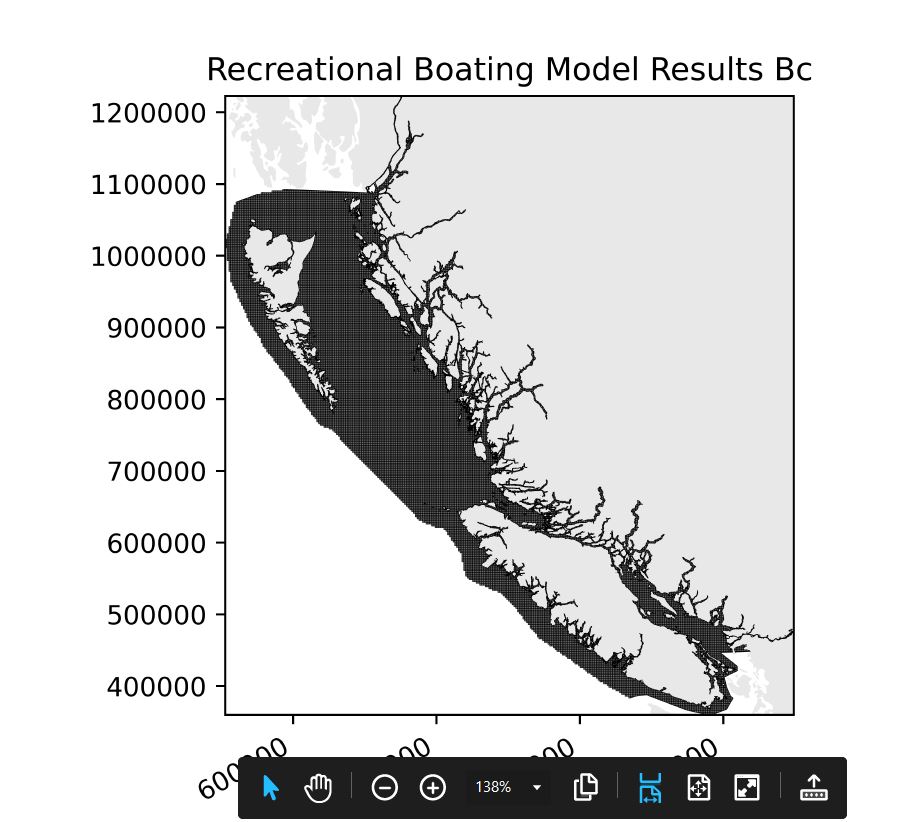
Description: Data on recreational boating are needed for marine spatial planning initiatives in British Columbia (BC). Vessel traffic data are typically obtained by analyzing automatic identification system (AIS) vessel tracking data, but recreational vessels are often omitted or underrepresented in AIS data because they are not required to carry AIS tracking devices. Transport Canada’s National Aerial Surveillance Program (NASP) conducted aerial surveys to collect information on recreational vessels along several sections of the BC coast between 2018 and 2022. Recreational vessel sightings were modeled against predictor variables (e.g., distance to shore, water depth, distance to, and density of marinas) to predict the number of recreational vessels along coastal waters of BC. The files included here are: --A Geodatabase (‘Recreational_Boating_Data_Model’), which includes: (1) recreational vessel sightings data collected by NASP in BC and used in the recreational vessel traffic model (‘Recreational_Vessels_PointData_BC’); (2) aerial survey effort (or number of aerial surveys) raster dataset (‘surveyeffort’); and (3) a vector grid dataset (2.5 km resolution) containing the predicted number of recreational vessels per cell and predictor variables (‘Recreational_Boating_Model_Results_BC). --Scripts folder which includes R Markdown file with R code to run the modelling analysis (‘Recreational_Boating_Model_R_Script’) and data used to run the code. Methods: Data on recreational vessels were collected by NASP during planned aerial surveys along pre-determined routes along the BC coast from 2018 to 2022. Data on non-AIS recreational vessels were collected using video cameras onboard the aircraft, and data on AIS recreational vessels using an AIS receiver also onboard the aircraft. Recreational boating predictors explored were: water depth, distance to shore, distance to marinas, density of marinas, latitude, and longitude. Recreational vessel traffic models were fitted using Generalized Linear Models (GLM) R packages and libraries used here include: AED (Roman Lustrik, 2021) and MASS (Venables, W. N., Ripley, 2002), pscl package (Zeileis, Kleiber, and Jackman, 2008) for zeroinfl() and hurdle() function. Final model was selected based on the Akaike’s information criterion (AIC) and the Bayes’ information criterion (BIC). An R Markdown file with code use to run this analysis is included in the data package in a folder called Script. Spatial Predictive Model: The selected model, ZINB, consist of two parts: one with a binomial process that predicts the probability of encountering a recreational vessel, and a second part that predicts the number of recreational vessels via a count model. The closer to shore and to marinas, and the higher the density of marinas, the higher the predicted number of recreational vessels. The probability of encountering recreational vessels is driven by water depth and distance to shore. For more information on methodology, consult metadata pdf available with the Open Data record. References: Serra-Sogas, N. et al. 2021. Using aerial surveys to fill gaps in AIS vessel traffic data to inform threat assessments, vessel management and planning. Marine Policy 133: 104765. https://doi.org/10.1016/j.marpol.2021.104765 Data Sources: Recreational vessel sightings and survey effort: Data collected by NASP and analyzed by Norma Serra to extract vessel information and survey effort (more information on how this data was analyzed see SerraSogas et al, 2021). Bathymetry data for the whole BC coast and only waters within the Canadian EEZ was provided by DFO – Science (Selina Agbayani). The data layer was presented as a raster file of 100 meters resolution. Coastline dataset used to estimate distance to shore and to clip grid was provided by DFO – Science (Selina Agbayani), created by David Williams and Yuriko Hashimoto (DFO – Oceans). Marinas dataset was provided by DFO – Science (Selina Agbayani), created by Josie Iacarella (DFO – Science). This dataset includes large and medium size marinas and fishing lodges. The data can be downloaded from here: Floating Structures in the Pacific Northwest - Open Government Portal (https://open.canada.ca/data/en/dataset/049770ef-6cb3-44ee-afc8-5d77d6200a12) Uncertainties: Model results are based on recreational vessels sighted by NASP and their related predictor variables and not always might reflect real-world vessel distributions. Any biases caused by the opportunistic nature of the NASP surveys were minimized by using survey effort as an offset variable.