 Arctic SDI catalogue
500000
Type of resources
Available actions
Topics
Keywords
Contact for the resource
Provided by
Years
Formats
Representation types
Update frequencies
status
Scale
-
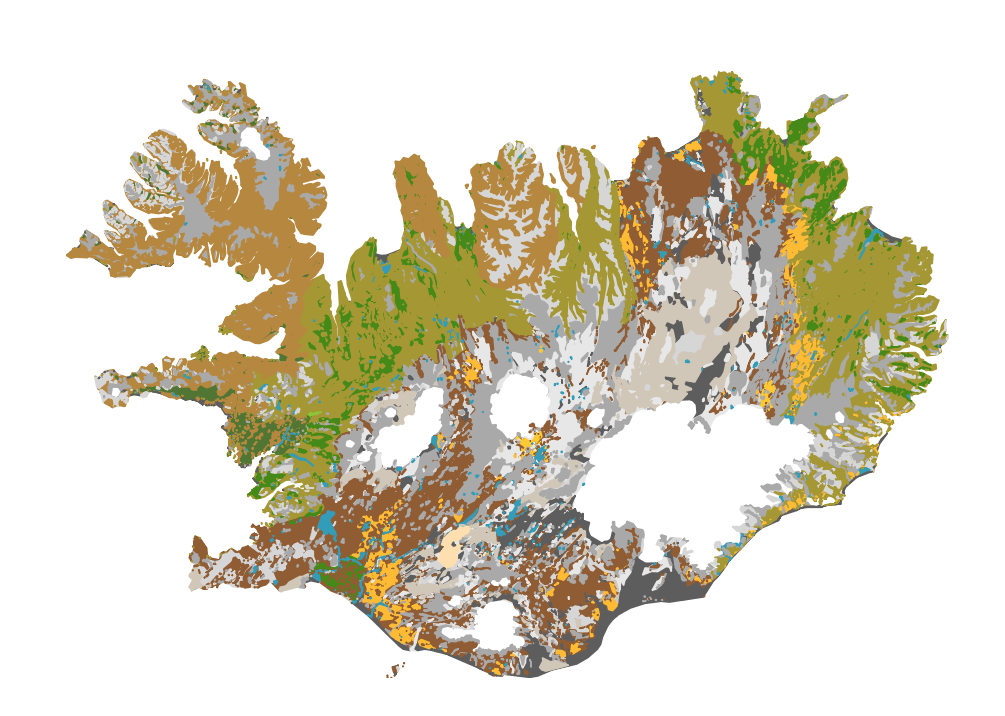
Íslenskur jarðvegur telst til eldfjallajarðar (Andosol) að langmestum hluta, en eldfjallajörð er jarðvegur sem myndast á eldvirkum svæðum heimsins. Eldfjallajörð hefur afar sérstæða eiginleika sem greina hana frá öðrum jarðvegsgerðum. Útbúin var einföld flokkun fyrir íslenskan jarðveg, sem m.a. byggist á alþjóðlegum flokkunarkerfum en einnig á vinnu Björns Jóhannessonar og Þorsteins Guðmundssonar. Flokkunin gerir greinarmun á i) jarðvegi auðna (glerjörð sem skiptist í melajörð, malarjörð, sandjörð og vikurjörð; ii) jarðvegi gróins lands með sortueiginleika (sortujörð, sem skiptist í brúnjörð, votjörð og svartjörð), iii) lífrænni mójörð og að síðustu iv) öðrum jarðvegi sem er margvíslegur að gerð. Í síðasta flokknum er bergjörð útbreiddust, en auk þess má nefna frerajörð sífrerasvæða og kalkjörð. Jarðvegskortið var unnið á grundvelli sniða og jarðvegssýna sem safnað hefur verið víða um landið. Kortið er á vektora formi og í mælikvarða 1:500 000. Það er m.a. hluti evrópska jarðvegskortsins. A soil map of Iceland: The Soil map classification separates between; 1) andic soils, which are Brown Andosols, Gleyic Andosols and Histic Andosols; 2) Vitrisols, soils of deserts, which are divided into Cambic Vitrisols, Gravelly Vitrisols, Arenic Vitrisols and Pumice Vitrisols iii) Histosols, and iv) other soil types such as Cryosols and Leptosols. The classification system is in part based on WRB system and Soil Taxonomy and earlier work by Björn Jóhannesson and Þorsteinn Guðmundsson (see English Summary and 1. table in http://www.moldin.net/uploads/3/9/3/3/39332633/jardvegskort_2.pdf). The map is in a coarse scale (1:500 000) and is not intended to use for particular points on the landscape. It is rather an overview. It has been incorporated into the EU soil database and the Circumpolar soil map.
-

Vatnsföll eru gjarnan flokkuð í þrjá flokka, dragár, lindár og jökulár eftir rennslisháttum. Mörg eru vatnsföllin þó af blönduðum uppruna vegna margbreytileika vatnasviða þeirra. Gagnasettið sýnir greiningu vatnasvæða í vatnafarsflokka, eftir því hvernig svæðið bregst við úrkomu og miðlar henni, og rennslisháttum vatnsfalla sem eiga uppruna sinn á viðkomandi svæði.
-
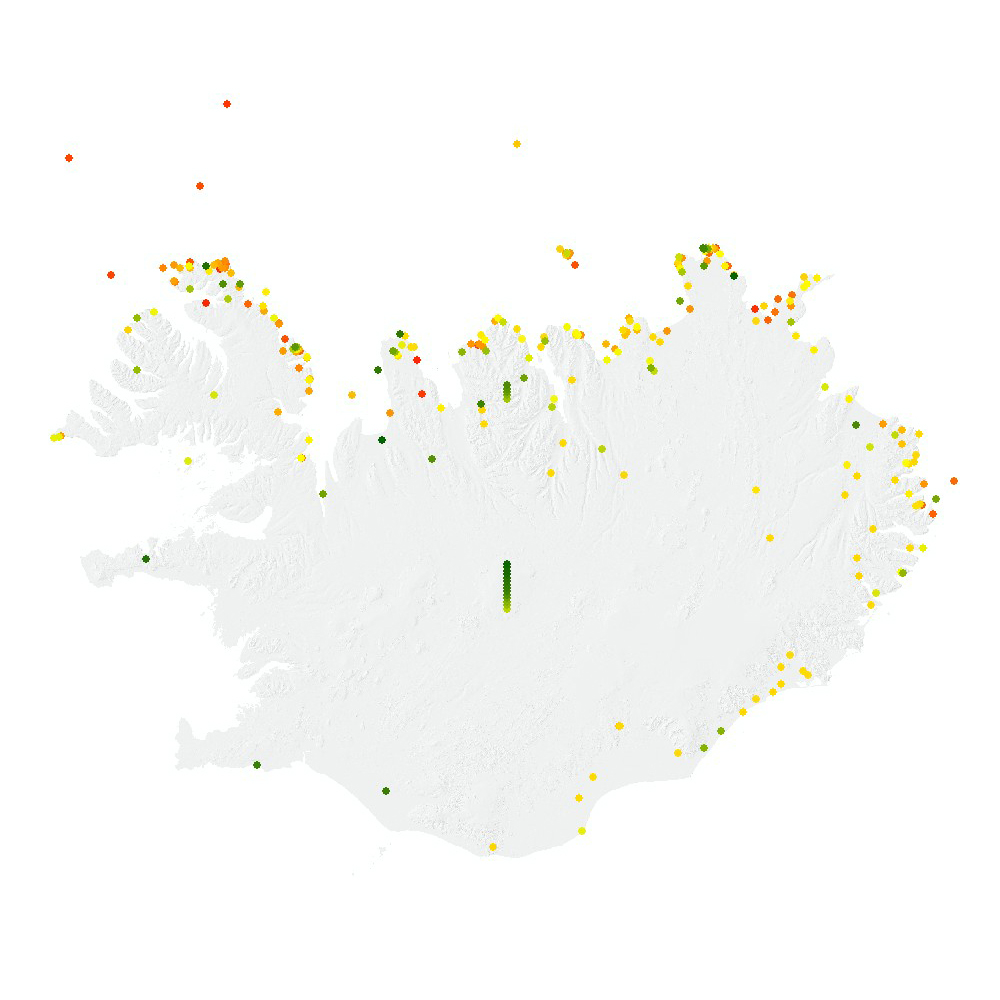
Dreifing hvítabjarna sem sést hafa á Íslandi í mismunandi mælihvarði. Þekja ni_G500v_hvitabjorn, punktalag. [Distribution of polar bear sightings in Iceland in different scales. Point layer ni_G500v_hvitabjorn.] Ekki er hægt að tala um hvítabirni sem íslenska tegund en þó hafa þeir tekið hér land af og til og teljast því til flökkudýra. Upplýsingar eru til um rúmlega 560 hvítabirni sem skráðir hafa verið hérlendis frá upphafi landnáms. Síðast varð vart við hvítabjörn við Höfðaströnd í Jökulfjörðum 2024. Viss ónákvæmni er þarna um að ræða því vafalaust hafa einhver dýr gengið hér á land án þess að menn hafi haft þar vitneskju um eða skráð sérstaklega. [Polar bears are not native to Iceland, although they do occasionally turn up in Iceland and are thus classified as vagrants. Information exists on just over 560 polar bears recorded as having arrived in Iceland from the beginning of human settlement on the island to the present day. This is a somewhat imprecise figure, since polar bears have undoubtedly come ashore without their presence going noticed, while bear sightings and encounters were not always documented in the past. The last polar bear observation was at Höfðaströnd, Jökulfjörður, Westfjords, in 2024. Table entries are in Icelandic.] Nákvæmni tíma [Accuracy of time]: varies depending on the source. If only the year of the sighting is known, you find this year under fitjueigindi 'ártal 1' (artal1). In case there are more details known, there are as well entries for fitjueigindir 'dags hvítabjarnakomur' (dagsHvitabjarnakomur) or 'ártið' (artid). If the year is not quite definit, there is an entry in fitjueigindi 'um' (um). Entries in both fitjueigindir 'ártal 1' and 'ártal 2' (artal1, artal2) define a timespan for the sighting. Nákvæmni staðarins [Accuracy of location]: varies depending on the source. All sightings for Íceland are grouped in the center of Iceland and the value for fitjueiginde 'nákvæmni XY' (nakvaemniXY) is '9000'. Sightings for Norðurland are grouped on Tröllaskagi, sightings for Norðvestur are placed in the center of the Vestfjords, sightings on Melrakki are grouped just off the north coast (nakvaemniXY = 3000 or 2000). If only the area is know, the data is placed in the center of the corresponding 10-km-reit (nakvaemniXY = 1000). If the location is known in detail, t.d. bæ, the entry for 'nakvaemniXY' is '100'. Sometimes the sources do not state the location of the sighting but the farm where the animal was processed [unnin]. And one has to keep in mind that a 'dot' in the data set can also represent an animal that has been in Iceland for a longer period of time and has traveled a longer distance. If there are several sightings for the same place or area, the entries are scatterd using a 1-km-reit system. Entries on age, sex, and size or weight are often missing. Fitjueigindi 'RM númer' (RMnumer) corresponds with the Natural History Collection of Náttúrufræðistofnun. Heimild [Source]: Náttúrurfræðistofnun Íslands and the publication: Rósa Rut Þórisdóttir 2018. Hvítabirnir á Íslandi. Reykjavík: Bókaútgáfan Hólar.
-

This group of maps, which includes the CanMatrix and CanTopo collections, is now a legacy product that is no longer maintained. It may not meet current government standards. Natural Resources Canada's (NRCan) topographic raster maps provide a representation of the topographic phenomena of the Canadian landmass. Several editions of paper maps have been produced over time in order to offer improved products compared to their predecessors in terms of quality and the most up to date information possible. The georeferenced maps can be used in a Geographic Information System (GIS). In all cases, they accurately represent the topographical data available for the date indicated (validity date). The combination of CanMatrix and CanTopo data provides complete national coverage. • CanMatrix - Print Ready: Raster maps produced by scanning topographic maps at scales from 1:25 000 to 1:1 000 000. This product is not georeferenced. Validity dates: 1944 to 2005 (1980 on average). Available formats: PDF and TIFF • CanMatrix - Georeferenced: Raster maps produced by scanning topographic maps at scales of 1:50 000 and 1:250 000. These maps are georeferenced according to the 1983 North American Reference System (NAD 83). Validity dates: 1944 to 2005 (1980 on average). Available format: GeoTIFF • CanTopo: Digital raster maps produced mainly from the GeoBase initiative, NRCan digital topographic data, and other sources. Approximately 2,234 datasets (maps) at scale of 1:50 000, primarily covering northern Canada, are available. CanTopo datasets in GeoPDF and GeoTIFF format are georeferenced according to the 1983 North American Reference System (NAD 83). Validity dates: 1946 to 2012 (2007 on average). Available formats: PDF, GeoPDF, TIFF and GeoTIFF
-
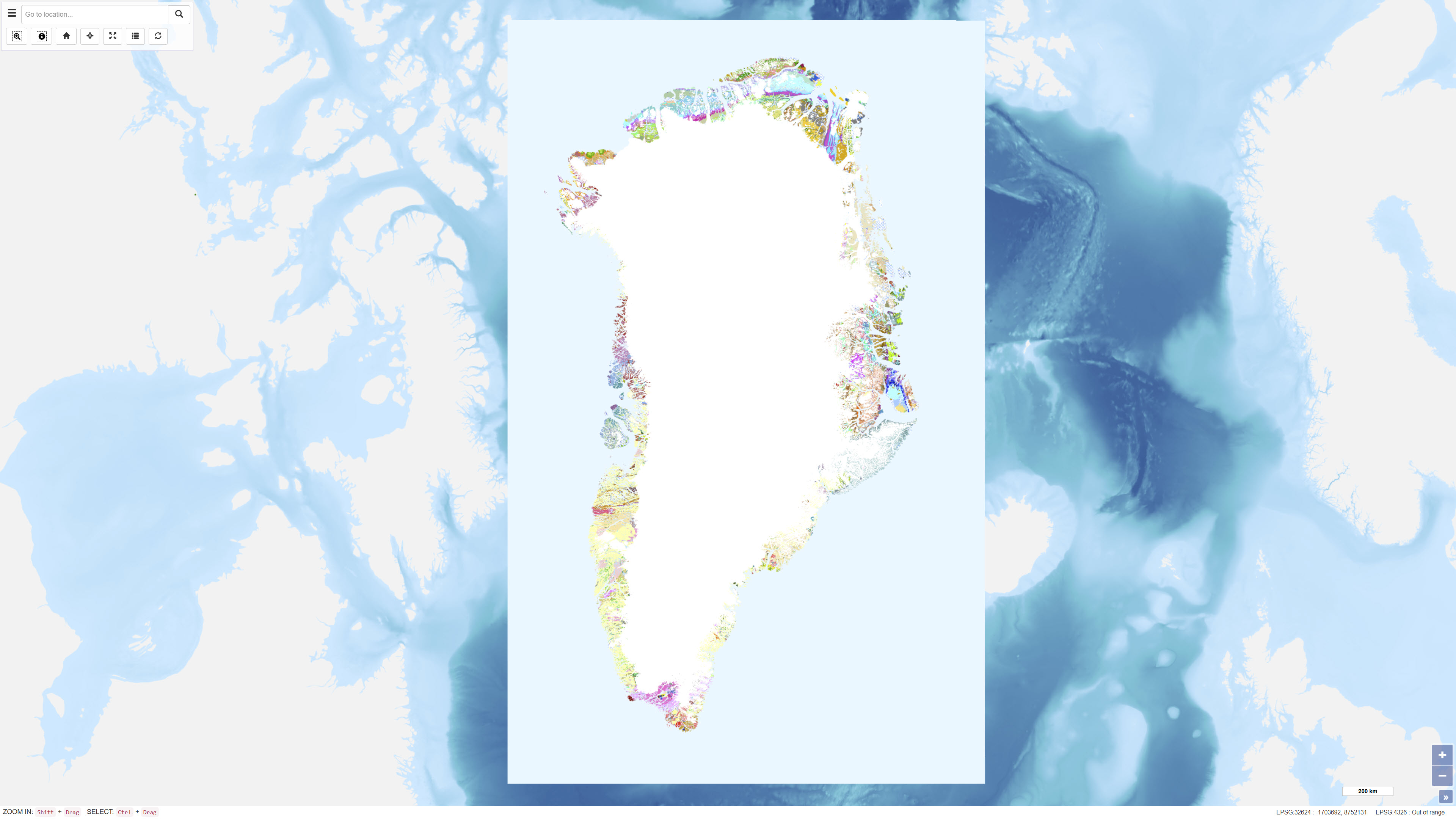
The geological map of Greenland at a scale of 1:500 000 is based on 14 digitised map sheets covering the whole of Greenland, with amendments in specific areas (Pedersen et al. 2013, GEUS Bulletin, DOI: 10.34194/geusb.v28.4727). The original digital version of the map was released through the Greenland Portal in 2012. Continued advances in geological knowledge have necessitated successive revisions in order to keep the map up to date. During the most recent update, a number of geographical areas were revised based on new geological data and interpretations, including parts of West Greenland, North Greenland, North-East Greenland, East Greenland and South-East Greenland. The updated map incorporates revised stratigraphic interpretations and improved representation of geological units and structures. The map has undergone extensive quality control, including complete harmonisation of lineaments and structural elements across map-sheet boundaries. The geological legend is dynamic and reflects the content of the current map view. Geological units are supported by descriptive information, and for most map polygons links are provided to a geological unit database containing further descriptions.
-
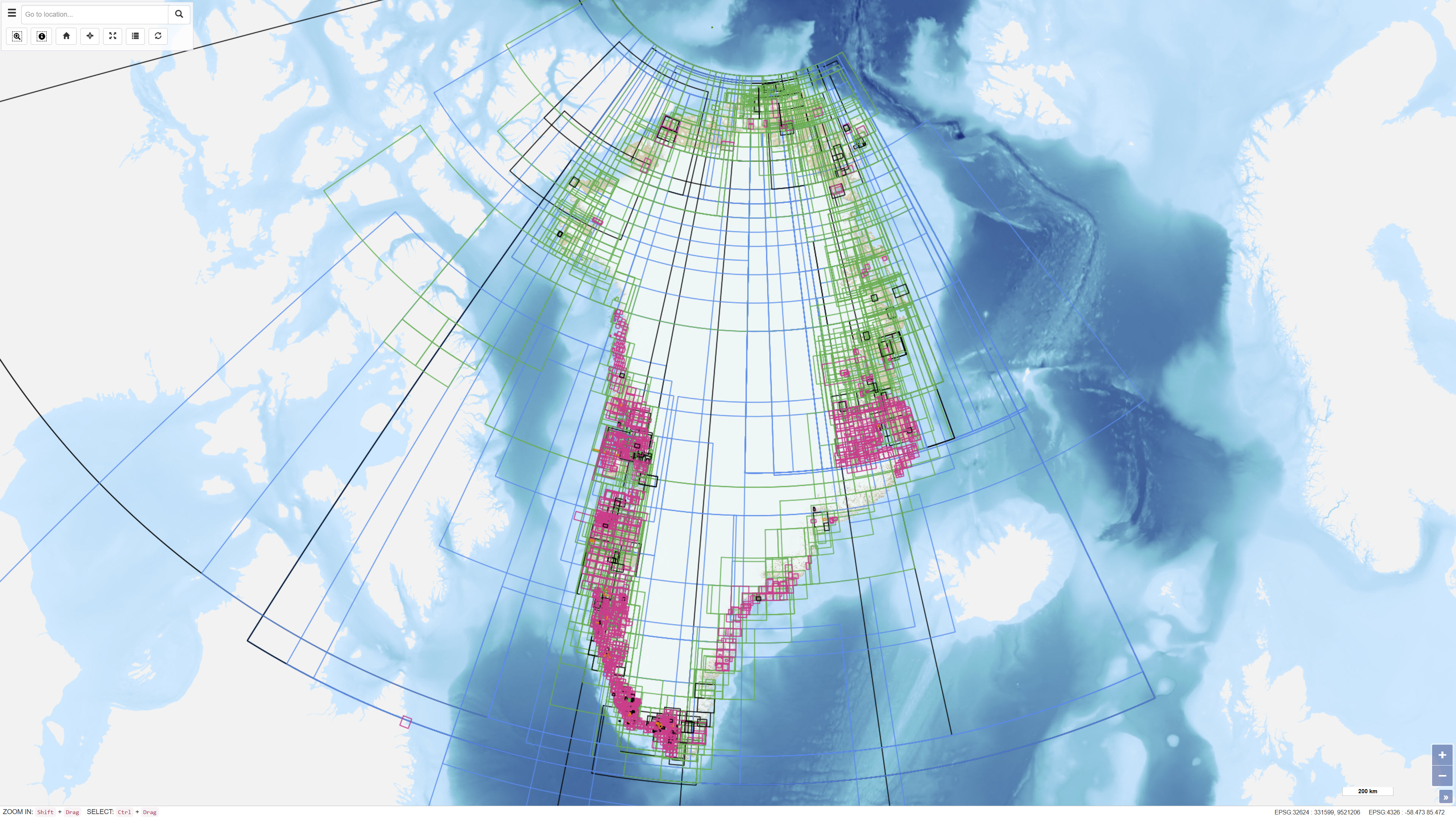
The dataset represents an index layer showing the geographic extent of archived and unpublished historical geological maps and sections from Greenland. The layer functions as a search and reference tool and does not contain the original map material. The dataset supports identification and access to historical geological archive documents.
-
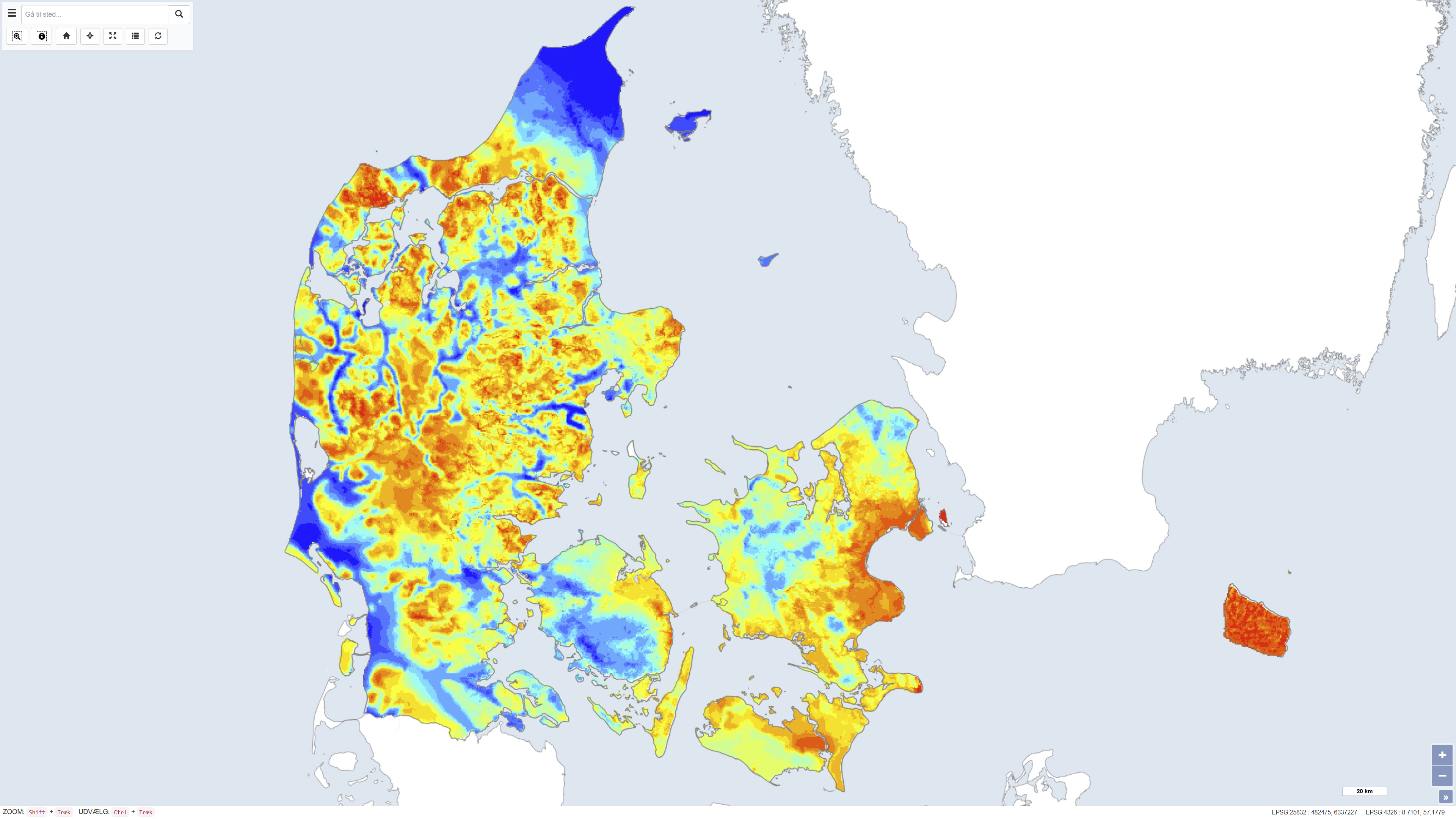
The dataset shows the thickness of Quaternary deposits in Denmark. The thickness has been calculated as the difference between surface elevation and the depth to the top of the pre-Quaternary deposits. The map provides a nationwide overview of variations in Quaternary thickness and is used in geological, hydrogeological and planning-related contexts.
-
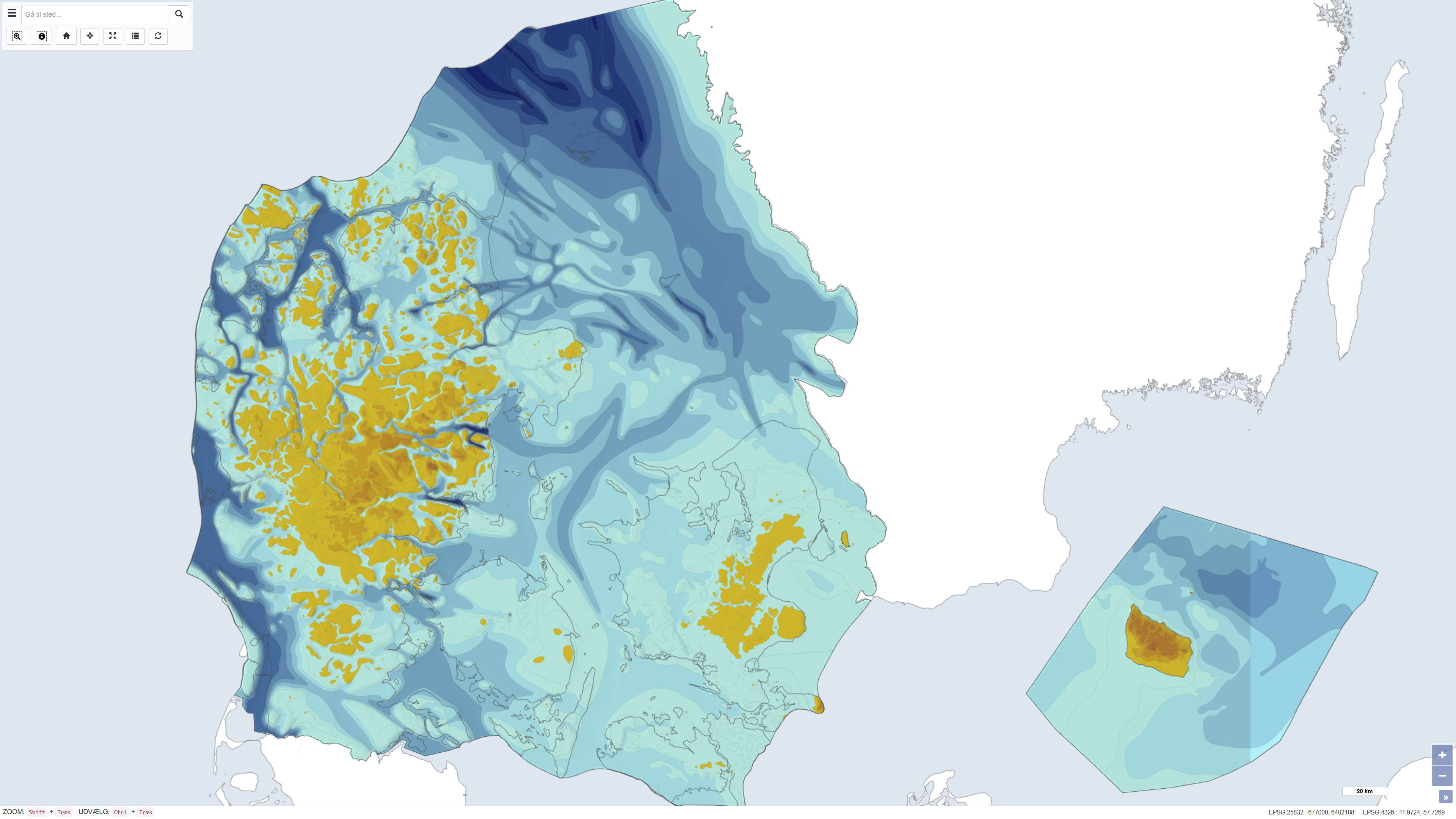
This dataset represents the pre-Quaternary surface topography of Denmark, including Kattegat, internal waters and the sea around Bornholm. The map provides a paleotopographic relief of the surface that existed prior to deposition of Quaternary sediments, compiled from geological borehole data, seismic surveys and topographic sources. It includes polygons with 25 m contour intervals, a 500 m grid and boundary delineations, usable in combination with a standard elevation model to determine Quaternary cover thickness. The base map was hand-drawn at 1:250,000 scale and forms a nationwide thematic map product. The map is described in DGU map series no. 44, 1994.
-
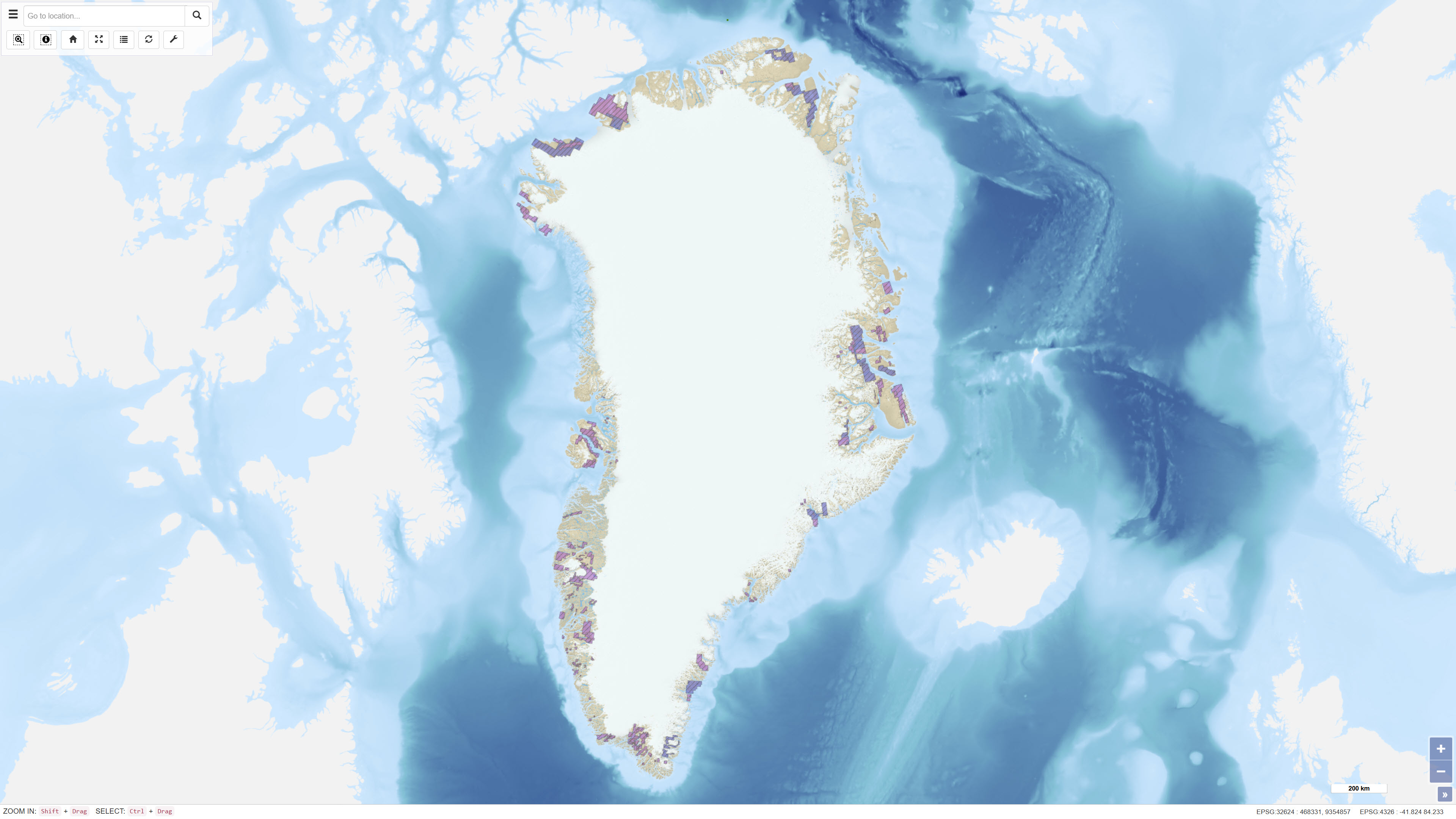
The dataset contains polygons representing historical exploration and exploitation licences for mineral resources in Greenland. The data are based on geographic information provided via WFS by the Ministry of Mineral Resources in Greenland and are redistributed without modification of the original boundaries. The dataset provides an overview of former licence areas and their spatial extent.
-
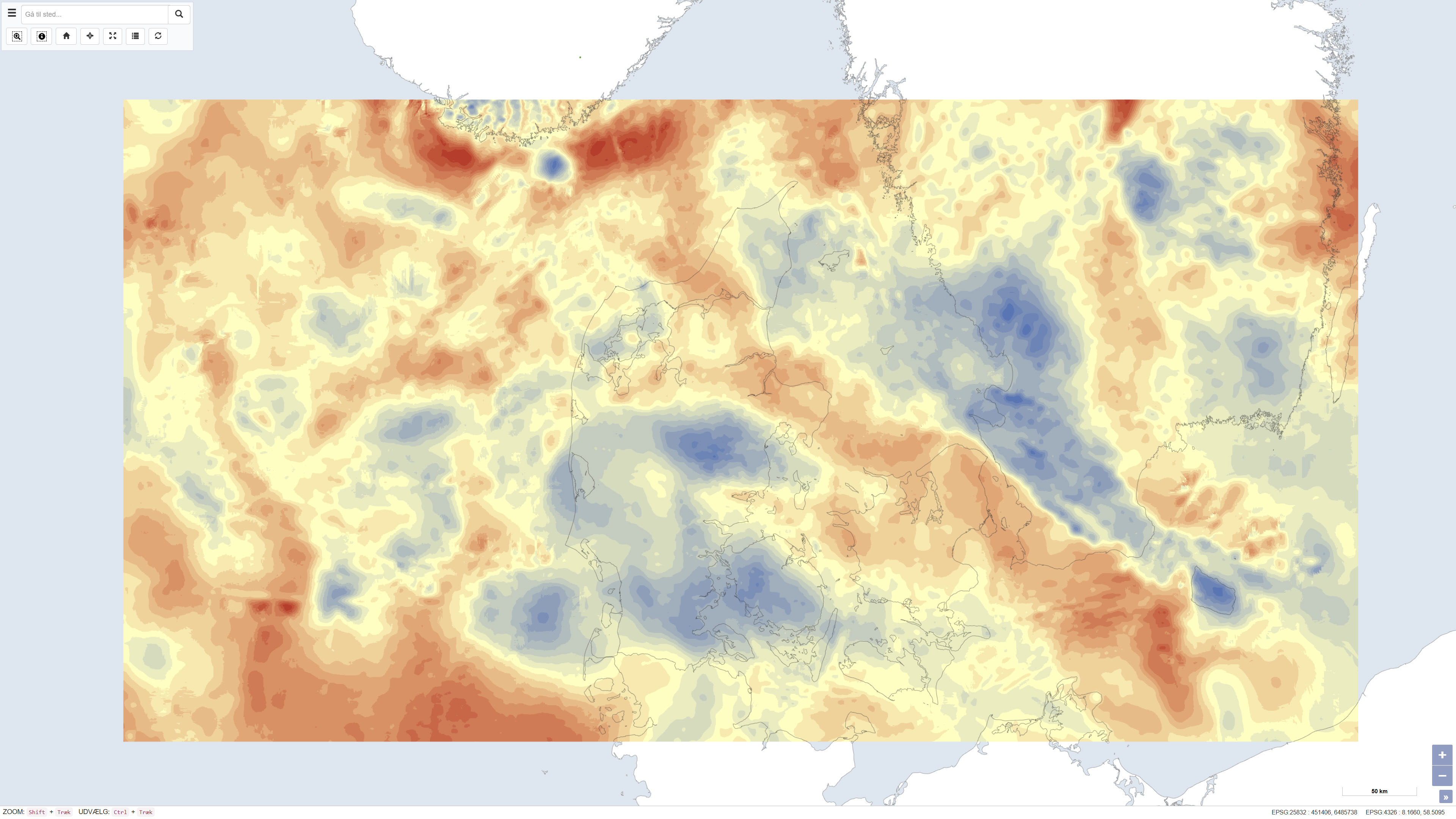
The dataset presents Bouguer gravity anomalies on land and free-air gravity anomalies in Danish marine areas based on gravity measurements from the national gravity database. The Bouguer anomaly is terrain corrected and is used to investigate variations in subsurface mass distribution, while the free-air anomaly at sea reflects variations in the gravity field without full terrain correction. Gravity anomalies are expressed in milligals (mGal). The dataset was produced by DTU Space and represents a consolidated gravimetric foundation for geological and geophysical analyses in Denmark.