 Arctic SDI catalogue
land
Type of resources
Categories
Available actions
Topics
Keywords
Contact for the resource
Provided by
Years
Formats
Representation types
Update frequencies
status
Service types
Scale
Resolution
-
Land Tenure for the Yukon Mining and Lands viewers
-
-
Created for distribution by the GeoYukon application as a comprehensive resource for all publicly available Mining information in the Government of Yukon. This data may be used directly by other applications to dynamically display Yukon data; however, it may be subject to change as data sets are updated or added.
-
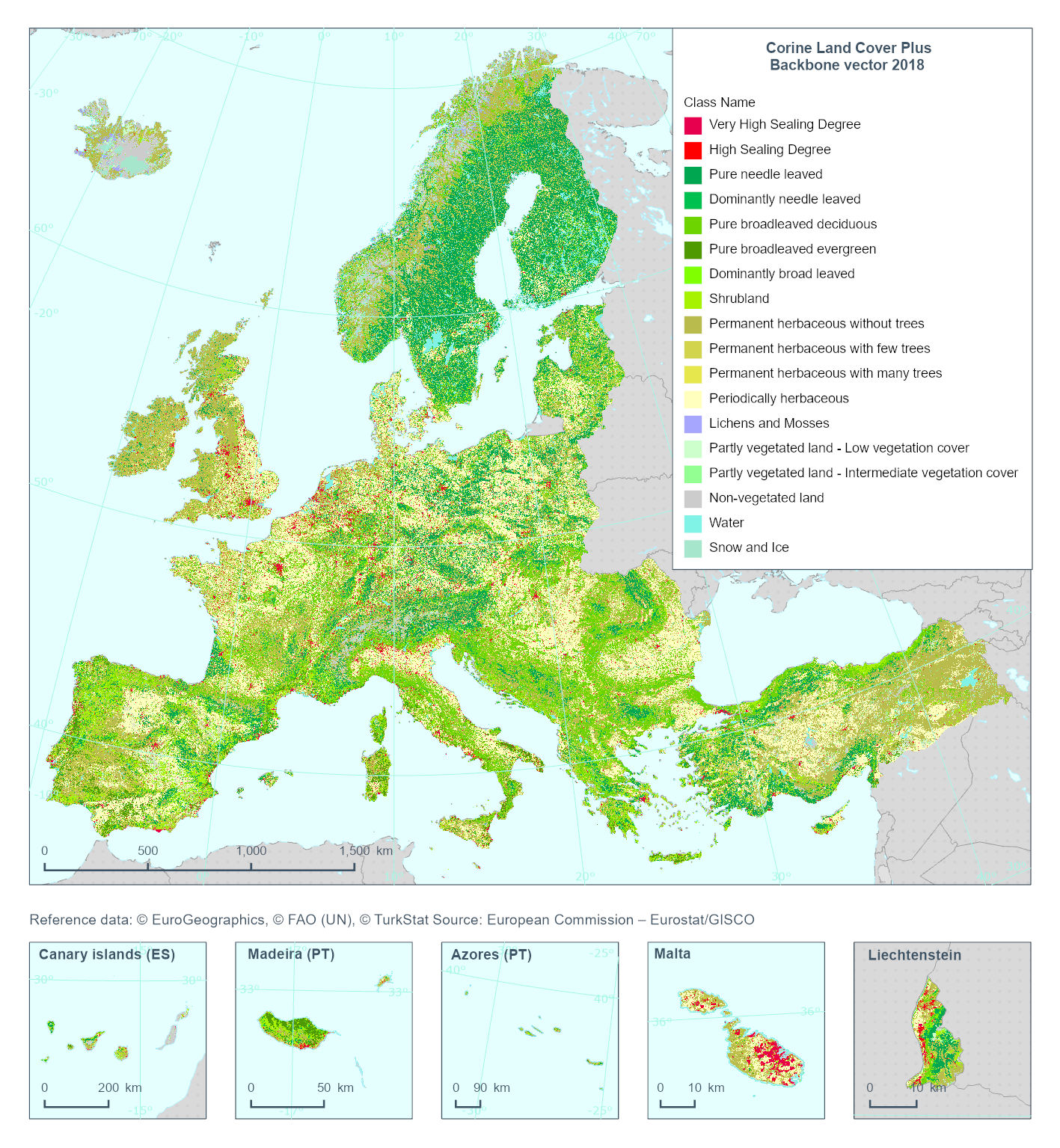
This metadata refers to the 'Corine Land Cover Plus Backbone' (CLCplus Backbone), a spatially detailed, large-scale, Earth Observation-based land cover inventory which is produced by the Copernicus Land Monitoring Service (CLMS). The CLCplus Backbone vector is a land cover map that contains vector polygon geometries (minimum mapping unit: 0.5 ha; minimum mapping width: 20 m) and is based on Sentinel satellite time series and a combination of existing reference datasets for geometries containing transportation and hydrological networks. Each polygon represents aggregated landscape objects and contains their dominant land cover among the 18 basic land cover classes. See polygon class codes in the additional information section. In addition, polygons are enriched with land cover fractions from the CLCplus Backbone raster as well as aggregated attributes based on other CLMS and Copernicus products (e.g. topography). CLCplus Backbone vector is an independent product and its thematic and geometric contents differ from CLCplus Backbone raster and Corine Land Cover. The CLCplus Backbone vector is available for the 2018 reference year.
-

An archive of 2D regional seismic and long period magnetotelluric data collected during 20 years of work under the LITHOPROBE project. Data are primarily onshore and cover widespread regions of Canada. Available data types include raw digital data, processed sections, and images of final sections, as well as auxiliary information required for analysis of the data.
-

To identify the limits of provincial parks in New Brunswick, to provide the public with a digital representation of the provincial parks, and to promote the use of a common geometric representation of the provincial parks of New Brunswick.
-
The Aboriginal Lands dataset consists of polygon entities that depict the administrative boundaries (extent) of lands where the title has been vested in specific Aboriginal Groups of Canada or lands which were set aside for their exclusive benefit.
-

An archive of 2D regional seismic and long period magnetotelluric data collected during 20 years of work under the LITHOPROBE project. Data are primarily onshore and cover widespread regions of Canada. Available data types include raw digital data, processed sections, and images of final sections, as well as auxiliary information required for analysis of the data.
-
This dataset consists of the provincial submerged land management areas. It was generated from data provided by the University of New Brunswick (under contract to Service New Brunswick).
-
Created for distribution by the GeoYukon application as a comprehensive resource for all publicly available Land Planning information in the Government of Yukon. This data may be used directly by other applications to dynamically display Yukon data; however, it may be subject to change as data sets are updated or added.